He Drank for 25 Years and Still Couldn't See the Problem
Updated: 1 day ago
Paul was 12 years old the first time he got drunk in a park with friends. By 14, he was sneaking into his mother's liquor cabinet, stealing vodka and filling the bottles back up with water. He knew something was off. He could feel it in the way one sip always demanded another, the way half a bottle would disappear and he wouldn't bat an eyelid. But sobriety was never a word that crossed his mind. Not at 14. Not at 24. Not even at 40, when the blackouts were getting worse and the anger was bleeding into every corner of his life.

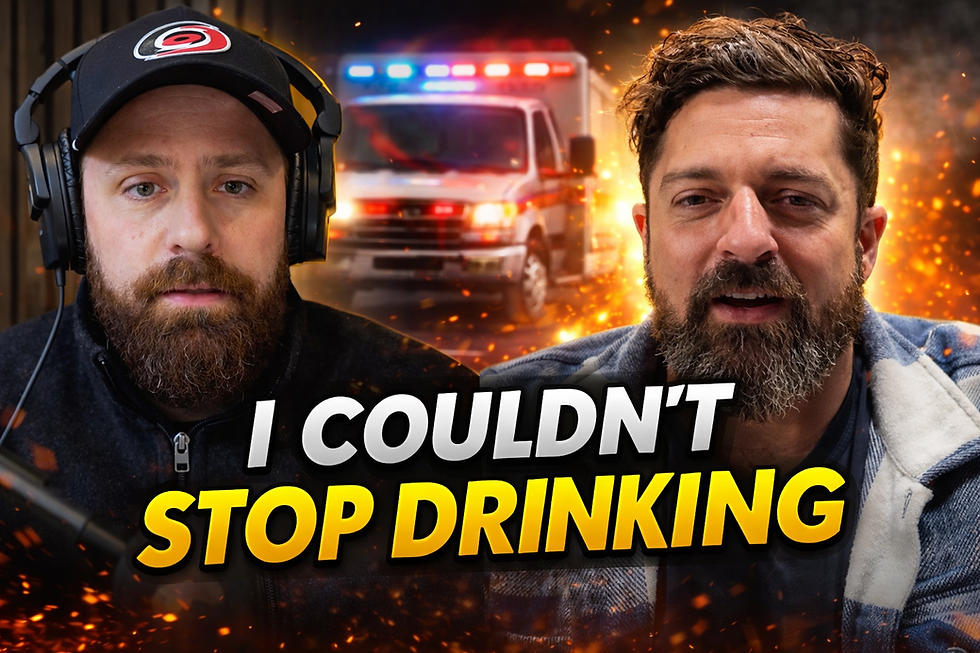
Denial in alcoholism is the inability to connect the damage in your life to the substance causing it, even when the evidence is overwhelming. For Paul, that denial lasted over 25 years. He went to AA, got into trouble with the law, nearly went to jail, almost died from blood poisoning, and still could not see that alcohol was the problem. His story, shared on the Sober Motivation Podcast, is one of the most honest accounts of what it looks like to quit drinking only after every other option has been exhausted.
This is what it looks like when the person who needs help the most is the last one to know it.
Growing Up in Chaos With a Drink in Hand
Paul grew up in Bedfordshire, on the outskirts of London. The landscape was green and beautiful, full of chalk hills and open fields where kids could ride bikes and explore. But inside his home, things were anything but peaceful.
He was raised in a single-parent household. His mother was young, and there was always a party happening. Christenings, birthday parties, weddings. Adults drinking, music playing, and alcohol everywhere. For Paul, access to drinking started before he could even understand what it meant.
"My superheroes or people I would look up to would be people that were involved in party lifestyle or involved in more criminal activities, which came with the party lifestyle."
At age eight, Paul experienced sexual abuse. He wouldn't talk about it, process it, or seek help for it until his late thirties and early forties, when he finally entered counseling. For decades, he carried that weight in silence, using whatever he could to numb the confusion and the pain: friends, partying, drugs, and above all, alcohol.
The First Drink That Changed Everything
Paul's first real experience of getting drunk happened at 12, in a park near his school. He didn't get sick. He didn't have a hangover. Instead, he felt something click into place. The shyness that had followed him through childhood, a quietness rooted in the abuse he'd suffered, suddenly lifted. He felt liked. He felt like he could be himself.
"Having that drink, that rush, that peeling everything back and being able to be liked, that was my first initial feeling. I was liked, I felt I could be myself. So it was a gateway to a different life or a different me, and I was never gonna put it down anytime soon."
That feeling became the foundation for everything that followed. Alcohol wasn't just recreation for Paul. It was a tool for survival, a way to show up in the world as someone other than the scared, quiet boy carrying a secret he couldn't name. For people searching for answers about why they can't quit drinking, this is often the missing piece. The substance isn't just a habit. It's solving a problem, even if it's creating ten more in the process.
Functioning on the Outside, Falling Apart on the Inside
By his thirties, Paul's life looked respectable on paper. He had two children, a stable relationship with a partner he'd known since school, a full-time job, money in the bank, and holidays. He played recreational rugby, which came with its own heavy drinking culture. To anyone looking in from the outside, Paul had it together.
But there was no inner peace. No real happiness. No joy that wasn't manufactured by a bottle of wine or a round of Jagermeisters.
"There was a real sadness there that I wasn't able to deal with and wasn't dealing with because I was just masking it. So there's a lot of fakeness and a lot of fake smiles and fake laughter."
This is the portrait of a functional alcoholic, someone who meets the basic requirements of adult life while quietly drowning. Paul paid his bills. He held jobs. He went on holidays. And he used every one of those facts as proof that he didn't have a problem. The ability to function became his greatest shield against the truth.
Check out Jason's Story Here
The Benchmarking Trap: How He Measured Himself Against "Real" Alcoholics
One of the most revealing parts of Paul's story is how he convinced himself, for decades, that he was fine. His strategy was simple: find someone who drinks more, or someone whose life looks worse, and measure yourself against them.
"I would measure myself against other people. I don't drink that much, just a few bottles of wine, a few beers. People in a pub have ten pints a night. I really benchmarked myself against the biggest alcoholic I could find. Or someone homeless, and I'd be like, yeah, he's worse, he's homeless."
This is one of the most common traps in alcohol denial. As long as you can point to someone further down the ladder, you can tell yourself you haven't fallen far enough to need help. Paul could work. He could pay his bills. He could maintain relationships, at least on the surface. So in his mind, the label of "alcoholic" belonged to someone else.
The reality was that people around him were hurting. His partner, his children, his family. They could see what he couldn't. But Paul's protective walls were built too thick and too early for anyone to break through, at least until the consequences became impossible to ignore.
When AA Didn't Stick
During COVID, Paul's drinking escalated sharply. Working from home meant he could drink from midday onward. Red wine became his constant companion, and he rationalized it: it's just red wine, it's not vodka, it's not spirits, what's the worst that could happen?
The anxiety got so bad that Paul could barely function. His employer's back-to-work care team suggested he try AA. He agreed, but with no real intention of stopping.
"I tried. I went and I had no intentions of stopping. I would go and soon as I finish, I'd go straight back to the pub. The first initial drink was to stop the anxiety."
For about three months, Paul attended AA meetings online while continuing to drink. He told them he was improving, that he was drinking less. They eventually signed him off, and the moment that support structure disappeared, he was right back where he started.
Paul's experience with AA is not uncommon. For some people, attending meetings without genuine readiness to change becomes another form of going through the motions. The structure is there, the community is there, but the internal shift hasn't happened yet. As Paul put it later: "They always say you won't quit until you really want to quit. And I believe that wholeheartedly."
[INTERNAL LINK OPPORTUNITY: suggest linking to a post about alternatives to AA or finding the right recovery path]
The Night Everything Broke Open
The turning point came on a Thursday night. It was supposed to be date night. Paul drank heavily at dinner, then came home and kept drinking on the sofa until he blacked out. But before he passed out, he was verbally abusive to his partner and his children.
It wasn't the first time. These Thursday nights had become a pattern. He would drink knowing he didn't have to work on Friday, and the alcohol would pull out the worst version of himself: angry, spiteful, venomous. And it was taking less and less to get him there.
What shook Paul to his core was the realization of who he was becoming. As a child, he had witnessed domestic abuse. He had been terrified of the man who committed it. And now, looking at his own behavior, he saw that man staring back at him.
"I was scared of turning into that man. And I was there, basically. It really took me to realize, hang on, I'm turning into something, this monster that I was never gonna turn into. That's something I saw as a child that I didn't ever want anyone else to see me be."
Even near-death from blood poisoning years earlier hadn't been enough. Dry January attempts and Dry November challenges had come and gone. But seeing himself become the thing he feared most, that was the line he couldn't cross.
On New Year's Day, Paul stopped drinking. That was over two years ago.
Building a Life Without the Mask
Paul white-knuckled the first three months. He couldn't sleep. He could barely talk. He was in a hole. But he leaned into what he knew: physical activity, walking, the gym.
Over time, the white-knuckling gave way to something more sustainable. Paul started counseling, initially for sobriety support, but it eventually opened the door to processing his childhood abuse for the first time. He discovered sober community groups, including the I Am Sober platform. He started listening to recovery podcasts, including the Sober Motivation Podcast, which he credits with helping him through those early, fragile months.
He also found new outlets for the energy and connection that alcohol once provided. He became a boxing coach, volunteering his free time to help young people and adults live healthier lives. He found spirituality through church. He started hiking, completing trails up Mount Snowdon, Scafell Pike, and the Three Peaks.
The old drinking friends are gone. Not out of resentment, but because Paul's life simply moved in a different direction. The connections he builds now don't require a drink to feel real. And for the first time, the people closest to him are seeing the authentic version of who he is.
His partner, who stood by him through the worst of it, told him he's a better person now. More understandable. Easier to talk to. A role model. When Paul finally shared his childhood experiences with her in sobriety, a lot of his past behavior suddenly made sense.
What Paul Wants You to Know
When asked what advice he'd give to someone struggling to get or stay sober, Paul's answer was simple: share what you're going through, and keep trying.
"Whether it's your first time, your seventh, or your seven hundredth time, just keep trying. And share those moments with people. You'd be really surprised how relatable they are. You're not going through it on your own."
Paul doesn't count days. He doesn't believe in treating sobriety like a countdown. What he does believe in is showing up, being honest, and building a support system that actually works for you, whether that's counseling, community groups, podcasts, physical activity, or all of the above.
His story is proof that you can drink for over 25 years, attend AA without it sticking, survive blackouts and blood poisoning and near-jail sentences, and still not see the problem. And it's also proof that when the moment of clarity finally arrives, however long it takes, it's never too late to quit drinking and start building something real.
The gap between who Paul was and who he wanted to be kept getting wider for decades. Today, that gap is closing. And he wouldn't go back for anything.
Frequently Asked Questions
Why can't some people see they have a drinking problem?
Denial in alcoholism often stems from comparing yourself to people who drink more or whose lives look worse. If you can still hold a job, pay your bills, and maintain relationships on the surface, it becomes easy to convince yourself the problem belongs to someone else. Underlying trauma and emotional pain can also make the idea of confronting the truth feel unbearable, which reinforces avoidance.
Can you quit drinking without AA?
Yes. While AA helps many people, it is not the only path to sobriety. Alternatives include counseling, therapy, online sober communities, recovery podcasts, fitness-based support groups, and platforms like I Am Sober. The key is finding a support system that resonates with your personal values and needs, and being genuinely ready to make a change.
What does it mean to white-knuckle sobriety?
White-knuckling refers to trying to stay sober through sheer willpower alone, without structured support or coping strategies. While it can work in the short term, it is often unsustainable and extremely difficult. Most recovery experts recommend combining willpower with therapy, community support, physical activity, and other tools that address the root causes of drinking.
How does childhood trauma contribute to alcoholism?
Childhood trauma, including abuse, neglect, and exposure to domestic violence, can create deep emotional pain that individuals learn to suppress. Alcohol becomes a way to numb that pain, quiet the mind, and feel accepted in social settings. Without addressing the underlying trauma through counseling or therapy, the cycle of drinking as self-medication often continues for years or even decades.
Is it normal to still think about drinking after getting sober?
Yes. Romanticizing alcohol after quitting is a common and normal part of recovery. The brain remembers the temporary relief and excitement that drinking provided, especially during times of stress. Building new routines, staying connected to a support community, and finding healthy replacements for the role alcohol played in your life are all essential for managing these moments without relapsing.
You don't have to do this alone. The Sober Motivation App has live sober meetings every day, a day counter, and a community that gets it. Download free on iPhone or Android.
Want more stories like this? Listen to the Sober Motivation Podcast.

Comments