He Watched His Dad Drink to Death. Then He Nearly Did the Same.
Updated: 1 day ago
When Don was a kid, he made a promise to himself: he would never drink. He had watched his father, a talented mechanic with a heart of gold and a bottle that never left his hand, slowly disappear. He watched him pass out at the wheel with Don in the passenger seat. He watched him nod out on the floor, an empty vodka bottle beside him, just minutes after promising over the phone that he was fine. He watched him die at 15 years old from alcohol addiction, alone in a bathroom.
Don kept that promise. For a while, anyway.
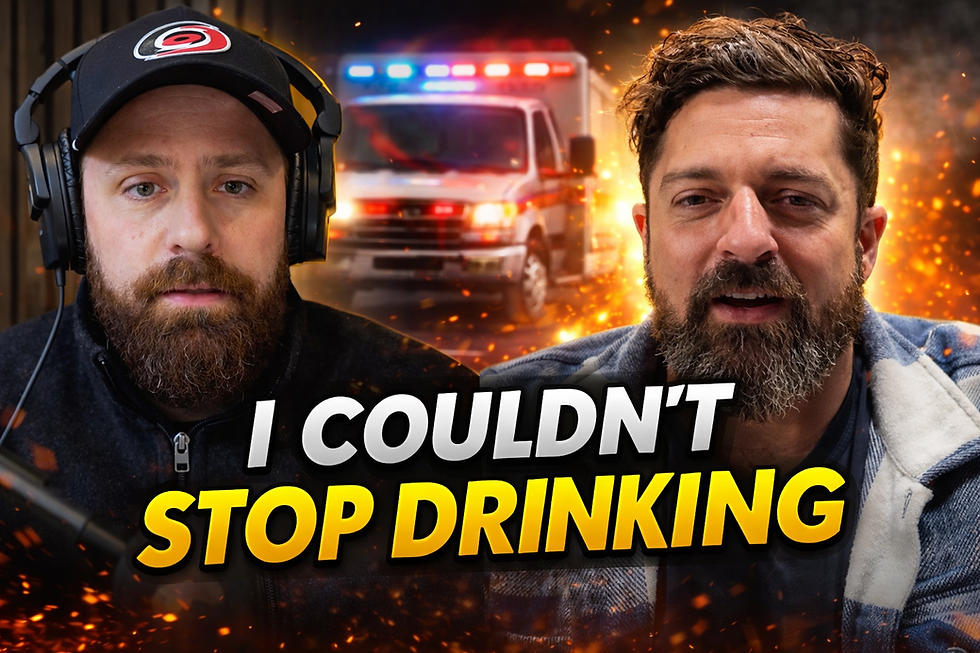
What unfolded over the next two decades would take him from Caribbean yachts to hospital beds to the floor of a hotel room in St. Thomas, where a stranger walked in and changed everything. Don joined us on the Sober Motivation Podcast to talk about quitting alcohol, finding purpose in sobriety, and how the life he almost drank away turned into something he could never have imagined sober.
The Father He Loved and Couldn't Save
Don grew up bouncing between his mom, who was young and largely absent, and his dad, who was present in the warmest, most chaotic way possible. His father was a diesel mechanic who could build anything, smelled like cigarettes and whiskey, and ran with a biker crew. Don adored him.
But his father was an alcoholic in the truest sense. Losing his license. Going to jail. Making promises he couldn't keep. Don watched all of it and told himself what a lot of kids of alcoholic parents tell themselves: I am never going to be like that. I don't even understand how somebody can let that happen.
At 15, he visited his father one afternoon. He called ahead to make sure he was okay, and his dad sounded fine. Don rode his bike the couple of miles over to his house. When he arrived, barely 35 minutes after that phone call, his father was on the floor, cross-legged with his head down, a full bottle of vodka gone.
"That's when I realized at 15 that something wasn't right," Don said. "I was angry at booze companies that they even sold it. Because I thought it was their fault. I didn't realize it was an internal thing."
A month or so after that, Don's father was dead. He had fallen in the bathroom and hit his head. He was 15 years old, and the man he loved most in the world had been taken by a bottle. He arrived at the hospital and his dad was already laid out.
"I was pissed," Don said. "I was like, how could you not pull your shit together? But lo and behold, many years later, I know what that feeling is like. That I can't stop feeling."
The Promise He Made and the Day He Broke It
For a couple of years after his father died, Don managed to hold the line. He fell in with a group of friends into punk rock, and one of them was straight edge: no sex, no drugs, no alcohol. Don rode with that. He meant it.
Then the friend who had gotten him sober offered him a drink. Don took it.
"I instantly felt like Brad Pitt," he said. "All my fears and worries went away. I went from being a shy, introverted, weird 16-year-old kid to feeling like I was a 25-year-old man. I felt confident and cocky. I got into a fight with the guy I was drinking with because I was teasing him."
He noticed right away that he was different from the other kids drinking that night. Some were giggly. One was crying. Don went off the rails immediately and loved every second of it. He said he should have known in that moment that something was different about the way his brain responded to alcohol. He didn't. He kept drinking, and the years kept moving.
The Long Drift Toward Rock Bottom
Through his twenties, Don kept it together enough to function. He did well in school. He got work. His first DUI came at 23 and he chalked it up to living in a small town. He was, he thought, just a normal guy who liked to drink. Then his grandfather died when Don was 24.
His grandfather had been the man who stepped in when his father couldn't. Patient, loving, unconditional. Don had known, even while his grandfather was still alive, that losing him was going to break something open.
"I was driving home one night," he said, "and I thought: when he dies, I'm going off the rails. I mentally checked out. It was either an excuse or just pain. But I knew."
He was right. After his grandfather passed, the drinking deepened and the drugs appeared. He started lying. He started losing jobs. He started becoming someone he didn't recognize when he looked in the mirror. The shame was building faster than he could drink it away, and the drinking was becoming harder to control with every passing year.
He found work living on private yachts, engineering in the Caribbean, and fell into a culture built around drinking. Nobody cared as long as the work got done. He thought he had found his world. What he had actually found was the perfect place to disappear.
"Every day I felt like I was crawling in my skin," he said. "Everywhere I went, not being able to look anybody in the eyes. Just being empty, trying to fix it with drinking. I don't know what hell looks like, but I can tell you what it feels like."
The Moment He Admitted He Was an Alcoholic
For years, Don resisted the word. Not because he didn't know the truth, but because of what admitting it would mean. If he was an alcoholic, then he was his father. And if he was his father, then the story could only end one way.
"That was the script I had in my head," he said. "If I admit I'm an alcoholic, I have to go out like him. And it scared the living hell out of me."
He got a DUI. He got into trouble. He burned through jobs on boats in St. Thomas and St. Martin, binged until they let him go, and told himself something else would be different next time. He went to his first AA meeting and walked back out. He picked up kratom when he tried to stop drinking, trading one addiction for another without realizing it. He went to a psychiatrist, got loaded up with psychiatric medication, and never told the doctor he was also drinking and using.
The relapses started getting shorter and more dangerous. What used to be months between binges became weeks, then days. Each time he drank again, the bottom came faster and harder. And then came the final one.
The Hotel Room in St. Thomas
Don had been sober for nearly a month on a yacht job. He was white-knuckling it with no support system, no sponsor, no sober friends, no faith. Just grinding through each day alone. Then he looked at his phone and found out his best friend had died.
The captain came up and saw him crying. He said the words Don had been holding the line against for a month: "I think you deserve that beer."
Don took it. Went below deck. Drank a full bottle of vodka. Left the boat. Went on a bender through St. Thomas for two days straight. By the time the wheels came completely off, he had missed his flight home, checked himself into a hotel with his savings, and was hiring taxi drivers to bring him alcohol because he couldn't get out of bed.
"The room started getting smaller," he said. "I went from going out and talking to people, to stuck in my room, to the TV off, to the room closing in. I accepted it. I was like, I'm ready to go. I couldn't do anything about it anymore. I couldn't stop."
He had been in that hotel room alone for a week when there was a knock at the door.
The Stranger Who Saved His Life
The man who knocked was the bellboy, a tall Jamaican man, six foot two, with dreadlocks. He looked through the door at the destruction inside the room, all beer cans and chaos, a man shaking in a bed. He asked Don if he was okay. Don said no. The man asked if he could come in.
He sat down next to Don on the bed and listened. He had been an alcoholic himself, and he understood exactly what was happening. He didn't lecture. He didn't call anyone. He just sat there, and then he started making a plan.
"He gave me a hug," Don said, his voice breaking. "He sat with me for a whole day. He took off from work and got someone else to cover him. He fed me beers one at a time to keep me from seizing. He researched, called some people from AA, packed all my bags, cleaned me up, and drove me to the airport."
The man talked to the security guard at the airport. He made sure Don got through. He stayed until the plane was boarding. Don looked at this stranger who owed him absolutely nothing and realized he was looking at something he hadn't expected to find at the bottom of a bottle in St. Thomas: grace.
He made it to Florida. He found a halfway house on the beach in Hollywood. He snuck beers in for a few days. And then, one morning, something shifted.
"I just came off everything," he said. "The booze, the psych meds, all of it. I sat in that room for a week just shaking, taking showers, sleeping, crying. And then I went for my first walk down to the beach."
What Actually Worked for Quitting Alcohol
Recovery for Don wasn't built on one thing. It was built on several things layered on top of each other, slowly, over time.
He found a sponsor, a quiet man who made jewelry and listened without judgment. He found a small group of sober friends his age who refused to let him talk badly about himself. Every time he said he wasn't smart enough or worthy enough or capable enough, they pushed back. Hard. He started going to the gym. He started meditating. He started writing gratitude lists every night, 15 things, which he thought was the dumbest idea he had ever heard until it quietly changed the way he saw the world.
And he started praying, in a way he could actually mean it. He had always pictured God as some distant authority figure who judged and kept score. At a retreat, a tattooed young pastor asked him to describe a perfect father instead. Don said: someone who shows up on a Harley with long hair, smells like brute cologne, smokes cigarettes, and tells me everything is gonna be okay. The pastor told him to pray to that.
"I started praying and just saying, God, I love you. I can't do this alone. I'm an idiot. Just keep me sober," Don said. "And then things started happening that I couldn't explain."
He got off kratom too, after a hard stretch of having to admit it had become its own addiction. He reset his sobriety date and grieved a month he thought he had earned. And then he kept going.
If You Feel Like This... You're Not Alone
If you are reading this and you have told yourself that you are too far gone, too broken, too different from everyone else, Don was there. He watched his father drink himself to death and then spent two decades walking toward the same end. He was in a hotel room on a Caribbean island, hiring strangers to bring him bottles, absolutely certain his story was over.
And then somebody knocked on the door.
"Get rid of the idea that you are defective," Don said. "Get rid of the idea that your life is junk. You are at a crossroads, and at any moment you can go down a different path."
He also offered something that stuck with me long after the conversation ended. He said that when the negative self-talk gets loud, talk to yourself the way you would talk to your 15-year-old self. Not with contempt. Not with shame. But with the kind of patience you would offer a kid who was just trying to survive something hard.
Because that is what we all were, once. Kids trying to survive something hard.
Key Takeaways from Don's Story
Fear of becoming your parent can keep you sick. Don resisted the word alcoholic for years because admitting it felt like accepting his father's fate. Naming the problem is not a death sentence. It is the beginning of a different story.
White-knuckling sobriety without support will eventually break you. Don was nearly a month sober on that yacht with no sponsor, no community, and no faith. All it took was one sentence from the captain. Isolation is not strength. It is just a longer way to fall.
Recovery is not one thing. For Don, it was gratitude lists, prayer, a sponsor, a handful of sober friends, the gym, meetings, and eventually a creative outlet. None of it worked alone. All of it worked together.
Sobriety changes what you are capable of. The opportunity that became a Netflix show found Don when he was newly sober, honest, and had nothing left to prove. He says it never would have worked if he had gone into it still drinking.
You are not defective. Don came to see alcoholism not as a flaw but as a laser-focused mind that had been pointed in the wrong direction. That same intensity, redirected, built a career, a YouTube channel, a shop, and a community.
Be easy on yourself. Sobriety does not promise an easy road. But Don said the moments of peace, smelling the trees on a bike ride, feeling the coffee cup in his hands, watching the sun come up clear-eyed, beat anything he ever felt drunk. Anything.
The Life He's Living Now
Don has his own hot rod shop. He has a YouTube channel that grew from zero to 100,000 subscribers. He is building a car his father always wanted to restore, an El Camino, and he is driving it to SEMA, one of the largest automotive showcases in the world, to debut it in his dad's name. He appeared in a Netflix show that hit the top four on the platform. He shows up for the friends who helped him when he had nothing.
He also prays every morning. Gets on his knees. Asks God to flow through his hands when he builds something and to keep him on the beam when everything else tries to pull him off.
"Waking up with a coffee in my hand, driving in my truck, actually feeling the vibrations through the steering wheel," he said. "I get to feel that now. That makes me tear up. We were built to be sober. We weren't built to be drunk every day. We were built to love, to give back, to be a part of this whole thing."
Don spent years chasing a high that kept moving further away. And then he stopped chasing, got honest, and watched his life become something worth waking up for.
If you are still in the middle of it, still trying to figure out if quitting alcohol is even possible for you, Don wants you to know: you deserve this. Not because you have earned it or proved yourself. But because you were born deserving it, and nothing that has happened since has changed that.
Listen to the Full Episode
Don's full conversation on the Sober Motivation Podcast goes even deeper into his journey through sobriety, faith, creativity, and what it took to rebuild a life from the ground up. If his story connected with you, listen to the whole thing. And if you are looking for more stories like this one, you are in exactly the right place. Every episode is proof that recovery is possible, that people do come back from places like this, and that the life waiting on the other side is worth every hard day it takes to get there.
Subscribe to the Sober Motivation Podcast and keep going. One story at a time.
You don't have to do this alone. The Sober Motivation App has live sober meetings every day, a day counter, and a community that gets it. Download free on iPhone or Android.
Want more stories like this? Listen to the Sober Motivation Podcast.


Comments