Can't Stop Drinking? Neither Could I. 13 Rehabs, TV Fame & What Finally Changed
Updated: 1 day ago
What does it look like to have everything the world says should make you happy and still be dying inside?
For Jason, it looked like a reality TV career, access, notoriety, and money. It also looked like 12 or 13 treatment centers between the ages of 18 and 23. Multiple arrests across multiple states. A suicide attempt. And a hollow, crushing emptiness that no amount of fame could touch.
If you've ever told yourself I don't have a good enough reason to quit drinking or on the flip side, I have every reason to quit and I still can't. Jason's story is for you. Because he lived both sides of that lie, and eventually found a way through that had nothing to do with hitting a dramatic bottom. It had everything to do with getting honest.
---
A Great Childhood With a Dark Undercurrent
From the outside, Jason's early years looked charmed. The youngest of four kids in a tight-knit, sports-obsessed family. Wakeboarding, motorcycles, surfing, family vacations. A mom and dad who were present, involved, and genuinely tried to help.
But around 12 or 13, something started breaking through the surface. Jason began struggling with severe OCD and not the kind people joke about. He washed his hands until they bled. He wore neoprene gloves packed with Neosporin just to keep the cracked skin from splitting open every time he made a fist. Doctors. Psychiatrists. Medication. His parents tried everything they could find.
What nobody had, back then, were the right tools to get at what was underneath. The awareness simply wasn't there. And so the symptoms got managed, sort of, while the root stayed untouched.
Then came alcohol.
"Who needs medication?" Jason reflects. It didn't hit him like a lightning bolt his first real encounter with drinking was actually a little anticlimactic. He was 13, his best friend's older brother had brought over a 12-pack, and Jason spent most of the night quietly pouring his drink over his shoulder. He was scared of losing control. But somewhere in the blur between that night and the years that followed, alcohol became a constant. And a problem.
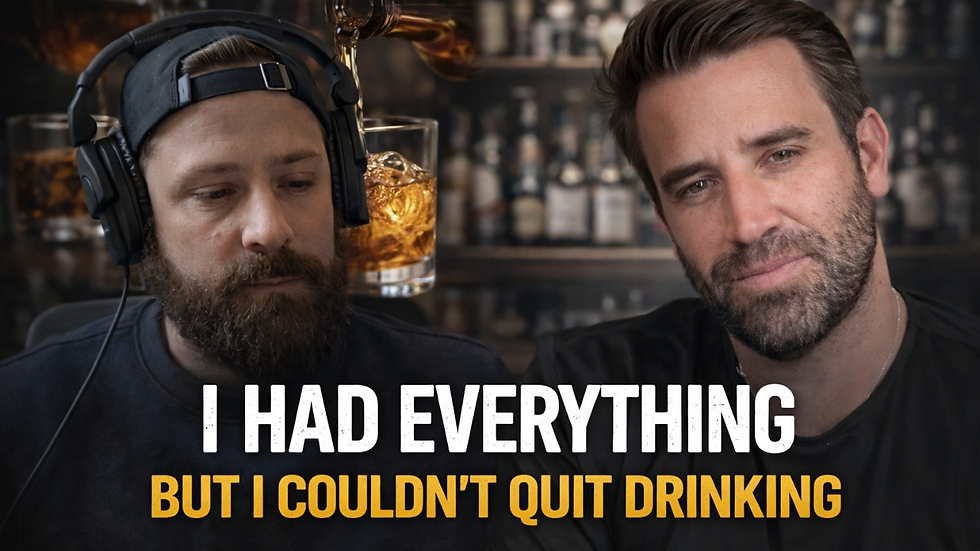
Fame, Fuel, and Freefall
By the time Jason was back from a wilderness program in Utah and a stint at a boarding school, a TV crew had been filming in his hometown. Laguna Beach was about to become one of the biggest shows on cable. Jason, fresh out of treatment at 17 or 18, walked right into it.
"I don't blame the shows for my addiction," he's clear about that. "It was already underneath there. It just definitely added fuel to the fire."
The show became The Hills. The access expanded. The drinking escalated. And from 18 to 23 years old, Jason cycled through 12 or 13 different treatment centers — Florida, Hawaii, every state in between. He was arrested multiple times. The tabloids had a field day. And there was no escaping it because it was all public, every stumble documented, every arrest a headline at the grocery store checkout.
"I use the acronym around shame," he says. "Self-hatred against my existence." That's what he was carrying underneath the camera-ready life.
The lowest points weren't just rock bottom — they went below it. Jason didn't just contemplate suicide. He attempted it. He was, by his own account, "the most empty person full of guilt and shame you could ever imagine."
Celebrity Rehab came next, completing a surreal arc from Laguna Beach to The Hills to a televised stint in treatment. And still, nothing stuck.
Why 13 Treatment Centers And He still Struggled
Here's something Jason is unflinchingly honest about: none of those treatment attempts were really for *him*.
"I was going to treatment for girlfriends, for my parents, for courts. It was never a true acceptance and a complete surrender."
That's the part most people don't want to hear when they're trying to get a loved one sober, or when they're trying to will themselves into quitting alcohol: the motivation has to shift eventually. External pressure can get you through the door. It cannot do the work for you.
Jason went through years of the cycle treatment, release, relapse, repeat not because the programs were wrong, but because he was never fully in them. Addiction, he says, is the only disease that tells you you don't have a disease. He was arrested four times in six months across four different states and still thought, genuinely, that this was just what being 21 and 22 looked like.
"You're trying to have a rational conversation with someone who is completely irrational."
The Turning Point: A Father's Tears
The moment of clarity, when it finally came, wasn't a dramatic intervention or a legal ultimatum. It was quieter and more devastating than that.
Jason was sitting in a therapy office with his parents yet again. His father, the steady patriarch of the family, the man Jason had only seen cry once before in his life, looked across at him with a tear running down his face.
*"Jason, we just don't know what to do anymore. Your mom and I, our marriage is suffering. The family is at a complete disarray. We're literally lying in bed like two plugs of wood, waiting for the phone call that you're dead."*
Something cracked open.
"I didn't care enough about myself," Jason says. "But you guys will become my motivation."
It wasn't the classic story of finally doing it for yourself. He's explicit about that, and he thinks the distinction matters. He went back into treatment on July 23, 2010 not because he loved himself enough, but because two people who loved him were being destroyed by watching him die slowly. That was enough. Just enough. And as the sobriety time accumulated, something shifted: purpose started to arrive. Passion. A self he actually wanted to be.
What Actually Worked
The years of quitting alcohol through willpower and compliance had taught Jason what didn't work. What finally worked looked different.
It was surrender real surrender, not treatment-center compliance. It was being completely open and honest, which he had never fully managed before. It was becoming coachable, taking direction, following suggestions from people who had gotten sober and stayed that way.
"I had to have the motivation forced on me," he says. "And that's okay. You don't have to arrive wanting it for yourself. But eventually it has to become yours."
Today, years into sustained recovery, Jason's daily routine is non-negotiable. Every morning: a gratitude list three things he's grateful for, and why sent to a group of 13 or 14 other men. Then the gym. Then a devotional and Bible reading. Then scheduled prayer blocks built into his calendar, twice a day, 15 minutes each. In the evenings, the same four questions with his kids every single night: What was good today? What could we improve? What are we grateful for? What's our goal for tomorrow?
He still sees a therapist weekly. He still attends meetings twice a week. He sponsors people in recovery. He is, in his own words, of service constantly and that transfer of energy, from self-obsession to genuine service, is something he credits as foundational.
"Everything that I was doing to get to four and a half years sober I stopped doing it. And I relapsed." He's clear-eyed about that too. A relapse after five years taught him that sobriety isn't a destination. It's a practice. The day you stop doing the things that keep you well is the day the ground starts shifting under you.
Key Takeaways
Motivation doesn't have to be perfect to be real. Jason got sober initially for his parents, not himself and it still worked. The goal is to get in the door. The deeper motivation comes later. Relapse isn't a sign you can't recover it can be a sign you stopped doing the things that were working, because what's predictable is preventable. The real work starts the day you leave treatment; a 30- or 60-day program is the training wheels, and recovery is what you build after. Simple routines beat complicated strategies every time gratitude lists, prayer, the gym, meetings, a sponsor. None of it is exotic, and the hard part isn't knowing what to do, it's doing it consistently on the days you don't feel like it. Honesty is the foundation not honesty for show, but complete, uncomfortable, ongoing honesty with yourself and with the people in your corner. And you don't have to wait for a dramatic bottom. The bottom is wherever you decide to stop digging.
If You Feel Like This… You're Not Alone
Maybe you've been to treatment. Maybe you've tried to quit drinking on your own and relapsed so many times you've stopped counting. Maybe you're not sure you even have a "real" problem because you haven't lost enough yet.
Jason had the money. The fame. The parents who moved heaven and earth to help him. Thirteen treatment centers. And for years, none of it was enough not because the help wasn't there, but because the one ingredient that changes everything honest surrender hadn't arrived yet.
That ingredient can arrive at any moment. It arrived for Jason in a quiet therapy office when his dad started to cry.
It might arrive for you today.
The heaviness you feel right now, the cycle that feels impossible to break this could be the last day you ever have to feel like this. Not because life suddenly gets easy, but because there's a path forward that actually works when you actually walk it.
There Is a Way Out
Jason is now married with three kids. He's built a life he couldn't have dreamed up during the years he was drowning. He runs the Change Your Brain Foundation alongside Dr. Daniel Amen, working to transform how the world understands and treats mental health. He moved halfway across the country to Tennessee something he says he couldn't have done when he was in active addiction. He couldn't move across the street.
The simplest thing he offers to anyone who is struggling right now?
"This could be the last day you ever have to feel like this if you're willing to get completely open, honest, and ask for help."
Not complicated. Not requiring a dramatic bottom. Not requiring that you already love yourself or already believe change is possible.
Listen to Jason's Full Story
This conversation goes deep — into family cycles, the role reality TV played in his addiction, the relapse that happened while his wife was in labor four floors above him, and the daily practices that have kept him grounded for years. It's one of the most raw and real conversations we've had on the podcast.
Listen to Jason's episode on the Sober Motivation Podcast which is available on Apple Podcasts, Spotify, and YouTube.
You don't have to do this alone. The Sober Motivation App has live sober meetings every day, a day counter, and a community that gets it. Download free on iPhone or Android.
Want more stories like this? Listen to the Sober Motivation Podcast.

Comments