I Never Hit Rock Bottom, But Alcohol Was Destroying Me From the Inside
Updated: 1 day ago
You're waiting for that moment. The one that's supposed to make it all clear. The DUI. The hospital bed. The intervention with crying family members. You tell yourself that when something really bad happens, that's when you'll know it's time to stop drinking.
But what if the worst thing alcohol does to you isn't something the world can see? What if the damage is quieter than that, something that lives in your chest at 2 a.m., replaying conversations you can never take back with people who are no longer here?
That's where John lived for over two decades. No arrest record, no rock bottom anyone would point to from the outside. But inside, he was carrying a weight that nearly crushed him. His story is proof that you don't have to lose everything on the outside to be losing everything on the inside. And it's proof that quitting alcohol can start long before things look "bad enough."
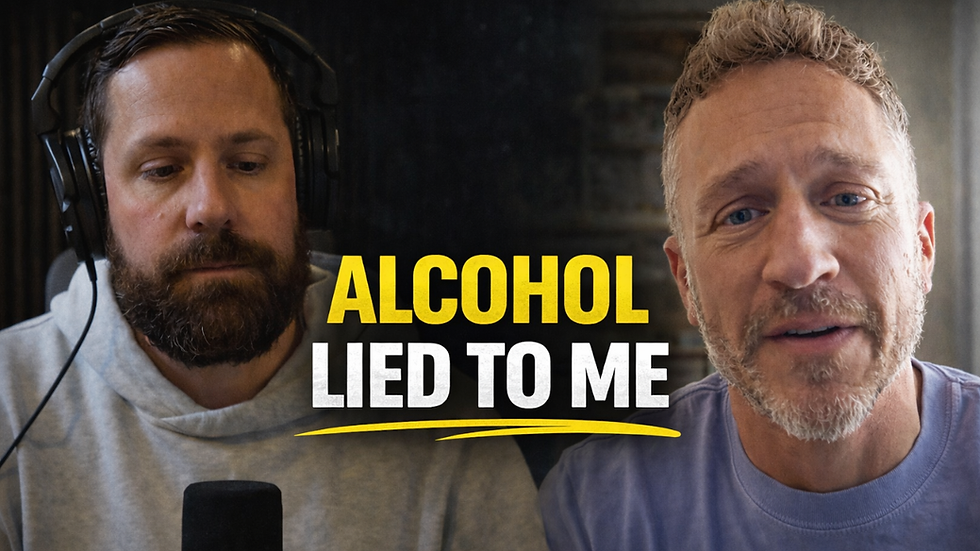
A Good Home With a Quiet Crack Running Through It
John grew up in a small, safe town in upstate New York. Two loving parents, two older siblings, a yard full of friends and wiffle ball games. On the surface, it looked like the kind of childhood most people would envy.
But underneath, things were shifting in ways a kid couldn't fully name. John was the youngest by over a decade, so by the time he hit second or third grade, his brother and sister had left for college and never really came back. His mom started working full time. His dad was already gone most of the day. Suddenly, the house full of people became very quiet, and John was on his own a lot.
Then, in the winter of seventh grade, everything changed. His mom sat him down and told him she and his dad were separating. No warning signs. No arguments he'd overheard. His parents had been in counseling for a year, and nobody in the family knew. That was just how things worked in their house. You didn't talk about the hard stuff. You buried it.
At eleven years old, John was asked to choose which parent to live with. He chose his house, his room, his yard, his friends. It didn't matter which parent stayed. He was staying. And that decision, made out of pure survival instinct, marked a turning point. He started connecting more with things than with people. Things were safe. Things didn't leave.
Drinking Looked Normal Because It Was Everywhere
John's earliest model for alcohol was his father. Dad stopped at the elks club after work, had a few drinks, came home, had more. He was, by definition, an alcoholic. But he wasn't a mean drunk. He wasn't absent or abusive. He was happy, present, and always wanted to spend time with his son.
So John absorbed the message early: this is just what adults do. Drinking is normal. His mom didn't drink, and she was the one who seemed like the odd one out.
By late high school, John started experimenting. Parties, stolen beer, someone's older brother buying a case. He didn't have that lightning bolt moment some people describe where the first drink unlocked something dangerous. For him, it was simpler than that. He liked being around people. Drinking put him in rooms with the "cool kids." It gave him a feeling of belonging he'd been quietly starving for ever since his family fractured.
College Hit Like a Freight Train
John left for Oswego State on Lake Ontario, and the spiral started almost immediately. The guy across the hall from his dorm was a year older, a fraternity member, and a heavy smoker who wanted a buddy. John was happy to oblige. Within weeks, he was high nearly every day, attending fraternity parties, drinking more than he ever had, and being introduced to harder drugs like acid and ecstasy.
He loved the sense of belonging. The fraternity shirts, the mansion on the lake, the feeling of being part of something that set him apart. School was an afterthought. He barely went to class.
By the end of his first semester, the college told him not to come back. His GPA was somewhere around 0.8. He went home, and there were no real consequences. His parents figured college was just a hard adjustment. Nobody knew what he'd actually been doing up there.
He enrolled at a local state school, kept working part-time, and picked up right where he left off. Fake ID, house parties, bars, driving drunk through rural roads. He was the kind of person who would take something first and ask what it was later. He snorted heroin. He sat in his car for hours smoking crack with a dealer. And somehow, he kept going. No arrest. No hospital visit. No one stepping in to say, "This isn't okay."
The Moments That Haunted Him More Than Any Rock Bottom
John's mother called him on a Saturday to say she was driving up to visit his new apartment. He'd been out all Friday night, likely mixing drugs and alcohol, and barely made it through his shift at work. He was short with her on the phone. Irritated. He just wanted to go home and sleep.
"Okay, cool. See you soon. Bye."
That was the last thing he ever said to her. She died in a car accident on her way to see him.
He was 21 years old. He drank all through the week of her funeral. At some point, he caused a scene around his family while drunk. He doesn't remember the details. As soon as the services were over, he wanted out from under everyone's eyes. His brother drove him back to school, dropped him off, and left. John immediately called his friends. They were sympathetic, sure, but they were also more than happy to buy him drinks and drugs.
His mother had a life insurance policy. John received around $30,000 in cash. He was 21 with a drug and alcohol problem. The money was gone in about six months. Five hundred dollars at a time from the ATM. Three hundred on cocaine, two hundred at the bar. Multiple nights a week. One stretch, he sat alone in his apartment for four straight days doing cocaine and drinking Captain and Cokes without speaking to another person.
He told himself he'd earned it. He'd been through something terrible. This was allowed.
Then He Lost His Father Too
Four years after his mother's death, John's father was diagnosed with cancer. John was living in Ithaca by then, working his first real job but still binge drinking, still popping Oxycontin before work, still smoking pot all day. He was taking half an oxy in the morning and another at four so it would hit on his drive home.
He and his sister took turns going home on weekends to help their dad through treatment. Laundry, groceries, keeping the house together. But John was tired of it. He was selfish, and he knew it even then.
One weekend, he drove home on a Friday, did what needed to be done by Saturday morning, then started loading his car to leave. He'd made plans with a friend to smoke weed, drink beers, and watch the NCAA tournament. He didn't tell his dad.
His father was sitting on the couch with an oxygen tube. He looked up and asked if John was leaving. John said yeah, he had stuff to do. His dad said, "Oh, I thought we were gonna watch the games tonight." Then, quietly: "All right, drive safe."
His dad passed away three days later.
John has carried that image for over twenty years. His father on the couch. The oxygen tube. The quiet disappointment. And himself, walking out the door to get messed up with his friends.
"My last two moments with my parents were tainted by my usage of drugs and alcohol," John said. "I can't make amends for these things. I can't apologize. I can't write a letter and make things better. All the therapy in the world, and it still hurts to acknowledge."
The Consequences Nobody Could See
This is the part of John's story that hits different from what you might expect from a recovery story. There was no dramatic intervention. No judge handing down a sentence. No losing a house or a career.
John's consequences were all between his ears. The regret. The shame. The guilt. The mental torment of replaying moments he could never fix. And for decades, he masked all of it with more drinking, more drugs, more pretending to be the fun guy at the bar while quietly falling apart behind closed doors.
"I never would have admitted I had a problem," he said. "I didn't drink daily. I didn't get the shakes. I could pour one glass of wine at home, put the bottle away, and forget about it. But if there was one person around me, I drank faster and more, every single time."
It was the social element. Being around people unlocked something in him, a need to drink in order to feel like he could show up, be interesting, be likable. He believes now that it traced all the way back to the unresolved grief and trauma he'd been burying since childhood. Alcohol was the bridge between who he really was and who he thought he needed to be around other people.
A Fresh Start in Charlotte, and the Slow Road to Clarity
At 31, John packed up and moved to Charlotte, North Carolina. No job lined up. He just knew he had to leave New York. He started experimenting with veganism, paleo eating, food blogging, website design. He found Buddhism, which cracked open a door to self-reflection and empathy he hadn't known was there. He finally quit smoking pot in his mid-thirties when he realized how dependent he'd become on it just to function through a normal day.
But he still hadn't addressed the drinking. He still hadn't gotten real help.
In his late thirties, he started dating for the first time in any real way. And a pattern emerged that he couldn't see until much later: he'd build confidence, meet someone, start drinking during the relationship, the relationship would fail, he'd isolate, gain weight, spiral into depression, then eventually claw his way back and do it all over again.
After one particularly painful breakup, he stopped drinking for four months, got into quality therapy, and joined a gym. Things started clicking. He felt genuinely good for the first time in his life. He marked May 17th on his calendar as the day he stopped drinking and watched the number of sober days climb.
268 Days Sober, Then One Glass of Wine
John met someone new while sober, and it felt like everything he'd been working toward. They fell in love quickly. He was upfront about not drinking, about his boundaries, about his past with drugs. They agreed on everything.
But things that had been hidden started surfacing. Drinking habits that didn't match what had been promised. Conversations shifted from "I want to change" to "Why do you have a problem with this?" to "If you love me, you'd love all of me."
John started wondering if he was the problem. He always had been before, right? And he made a decision he would come to deeply regret. He told himself that if he just had a drink, maybe he could handle it. Maybe he'd be more fun. Maybe it wasn't that big of a deal.
After 268 days sober, he ordered a glass of wine.
He didn't like it. He felt shame. But it wasn't enough to stop. The frequency increased. The quantity increased. Anxiety returned. Depression returned. He stopped going to the gym. He started lying to the people who cared about him. He even hid it from his therapist.
Nothing in the relationship improved. It got worse.
The Moment Everything Shifted
One day in therapy, John let something slip he'd been trying to hide. His therapist paused and said, "Sounds like you already know."
John went quiet. And that silence was the beginning of the end of his drinking.
Not long after, he found himself in a situation that showed him clearly that nothing was going to change in the relationship. He woke up, and he means that literally and figuratively. He stopped lying to himself. He drew a line in the sand, knowing full well it would end the relationship. And it did.
That was his last drink. Seven and a half months ago as of this conversation.
He got a tattoo that reads "Not for me. Not today." It's his daily reminder of what he's worth and a promise to never undersell himself again.
What John's Story Teaches Us About Quitting Drinking
John went on what he calls a "make amends apology tour." He reached out to people he'd pushed away, some he hadn't spoken to in over a decade. One friend had emailed him every single year for twelve years just to say he was thinking of him. John had ignored every one. He finally wrote back, admitted what he'd done, and said he was sorry.
Every single person was grateful to hear from him.
"That emotional burden I'd been carrying," John said. "Finally getting it off my shoulders after all those years. It was freedom."
Key Takeaways from John's Recovery Story
You don't need a dramatic rock bottom to have a real problem. John was never arrested, never hospitalized, never lost a job. But alcohol stole years of his life, poisoned his most important relationships, and left him with regrets he can never undo. If you're questioning your drinking, that question itself is worth paying attention to.
Internal consequences are just as devastating as external ones. The shame, guilt, and regret John carried for decades did as much damage as any courtroom or hospital could. Mental torment is not a lesser form of suffering just because no one else can see it.
Unresolved grief and trauma don't go away on their own. John buried the pain of his parents' separation, his mother's death, and his father's death under layers of drugs and alcohol. None of it disappeared. It compounded. Getting real help through therapy was one of the most important steps in his recovery.
Sobriety reveals patterns you couldn't see before. It wasn't until John experienced a relationship both sober and drinking that he could clearly see what alcohol was doing to him mentally, physically, and emotionally. That clarity became the foundation for lasting change.
Having a passion or physical outlet can be a lifeline. John noticed that the darkest periods of his life were when he had nothing challenging or meaningful to pour himself into. MMA, the gym, and physical fitness gave him something healthy to care about and build his identity around.
It's never too late to make amends and rebuild connections. Reaching out to people he'd hurt or abandoned was terrifying, but every single person responded with openness and gratitude. The weight of carrying those broken relationships was heavier than the vulnerability of picking up the phone.
If You Feel Like This, You're Not Alone
Maybe you've never been arrested. Maybe your boss doesn't know. Maybe your family thinks you're just going through a phase or blowing off steam. Maybe you look at other people's stories and think, "I'm not that bad."
But late at night, you know something isn't right. You feel the gap between who you are and who you're pretending to be. You replay moments you wish you could take back. You tell yourself you'll deal with it tomorrow, next week, after this rough patch passes.
John lived that way for over twenty years. And the one thing he wants you to know is this: you don't have to wait for something terrible to happen. The fact that you're even thinking about it means something. AA isn't going to check your rock bottom at the door. No sober community is going to turn you away for not having suffered enough. You belong there if you say you do.
There's Still Time to Choose Differently
John spent most of his life believing his anger, his grief, and his loneliness were just things he had to carry alone. He thought independence meant never asking for help. He thought toughness meant swallowing the pain and washing it down with whatever was available.
At 47, he's finally learning that the bravest thing he's ever done isn't white-knuckling through another hard day. It's opening his mouth and telling the truth. To a therapist. To old friends he'd abandoned. To strangers on a podcast. That's where the real freedom lives.
If you're sitting where John sat, carrying things no one else can see, know this: sobriety isn't just about putting down the drink. It's about picking yourself back up and deciding you're worth more than the story you've been telling yourself.
You are. And it's not too late.
Listen to John's Full Story
This blog post is based on John's conversation on the Sober Motivation Podcast. If his story resonated with you, listen to the full episode to hear him share these moments in his own words. Sometimes hearing someone else say the thing you've been feeling is exactly what you need to take that first step.
Explore more recovery stories on the Sober Motivation Podcast, and if you're looking for a community that gets it, you're already in the right place.
You don't have to do this alone. The Sober Motivation App has live sober meetings every day, a day counter, and a community that gets it. Download free on iPhone or Android.
Want more stories like this? Listen to the Sober Motivation Podcast.
Comments