Two Seizures, Three DUIs, and the Day He Finally Quit Drinking
Updated: 2 days ago
He was on his way into the liquor store when it happened. His body hit the floor before he knew what was coming. He woke up in an ambulance with EMTs screaming at him, blood from a gash across his face, and no idea how he had gotten there. The doctors stitched him up, told him to go to detox, and he asked if he could come back Monday because his birthday was the next day.
They let him leave. He went straight to the liquor store. He had another grand mal seizure in the parking lot before he made it inside.
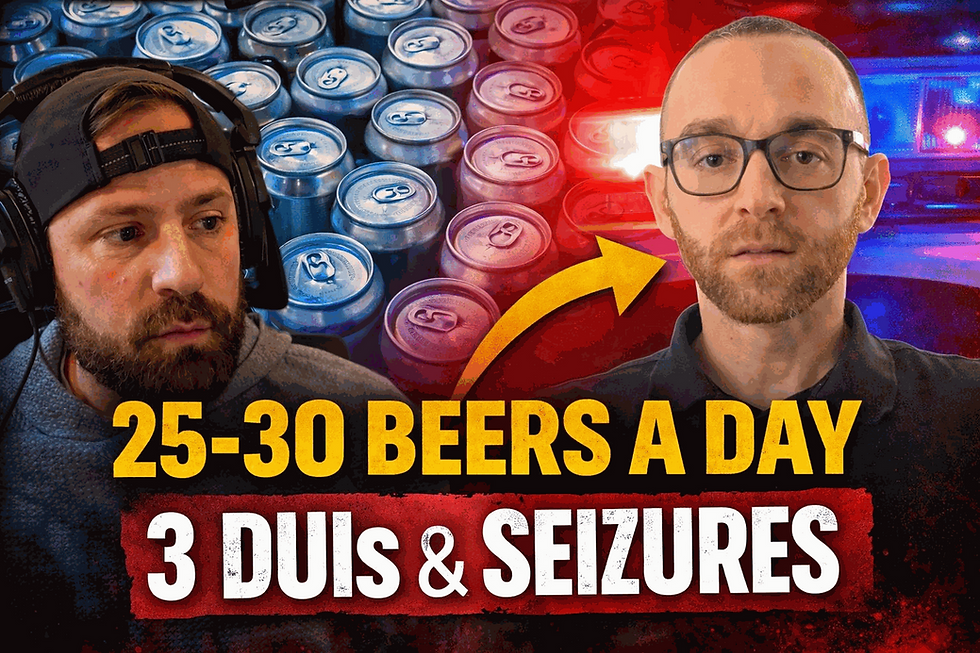
Derrick's story is not a quiet one. Three DUIs, withdrawal seizures, 25 to 30 beers a day, and a birthday spent in a chemically induced coma while his body went through delirium tremens. It is also a story about what happens after all of that. Because Derrick has been sober since October 22nd, 2016, is married with a family, has spent nearly a decade building a career in banking, and recently published a novel about addiction and legacy that is already changing lives.
He joined us on the Sober Motivation Podcast, and this is his story.
Growing Up Watching It Happen
Derrick grew up in the suburbs and describes his first decade of life as peaceful and normal. Then his older brother started experimenting with drugs, eventually getting deep into cold and congestion pills that, taken in large enough quantities, produced a high. That escalated into harder substances. Around the same time, his mother started drinking more heavily. The house that had been stable started to feel chaotic.
What struck Derrick most was not the chaos itself but the way it hollowed people out. He watched his father lose his patience. He watched his mother act differently, smell like alcohol, and not be fully present. He watched his brother come home wrecked from things nobody was talking about directly. And he made the same promise a lot of kids in that situation make.
"I said I'm never gonna drink," Derrick said. "I'm not gonna be that guy. I'm seeing what this is doing to the family and I'm gonna live my life sober."
He also learned early how to keep quiet. In his house, what happened at home stayed at home. His friends would complain about not getting the car for the weekend, and he was sitting on the knowledge that his brother had come at him with a butcher knife. He never figured out how to say that out loud. So he didn't say it at all. He just kept going and kept it all inside, where it built up quietly for years.
The First Drink and the First Warning Sign
Derrick held out longer than most. Through most of high school he stayed away from alcohol entirely, even as things at home got louder and harder to ignore. Then during his senior year, he and his best friend started sneaking into his friend's father's liquor cabinet. A shot of whiskey in some orange juice. Nothing dramatic. Nothing that felt like a warning.
Then at a graduation party, he sat down with a bottle of Jameson and kept sipping. His friend looked over at one point and told him he had had quite a lot. Derrick immediately went into the spins. The hangover lasted three days.
He did not touch alcohol again for a while. He went to community college near home, watched his high school friends go off and build their social lives, and tried to fit into new circles where drinking was part of the social fabric. He felt awkward not drinking at parties. He held water and answered questions about why he was not drinking. He hated how it felt to be the only sober person in the room.
At 21, at a hookah bar with friends who had never seen him drink, he ordered a martini. Then a second one. His friends cheered him on like it was a celebration. It was, in a way. What he did not know yet was what he was celebrating the beginning of.
"It was off to the races from there," he said.
The Restaurant Business and the Slow Slide
Derrick got into the restaurant industry, which meant late nights, a built-in culture of after-work drinks, and almost no barriers between the job and the bar. Drinking a couple of nights a week became drinking every night. He was 21 and could pull an all-nighter and show up to class or work the next morning without too much damage. He told himself this was just what that age looked like.
But he knew. He knew because he watched his friends have one or two drinks and leave, while he was slipping out to the bathroom to get himself to a certain level before he joined them at the table. He knew because he would pre-drink at a dive bar full of middle-aged guys before meeting his friends so that nobody would see exactly how much he needed. He knew because every time he told himself he was going to keep it to one or two, those were the nights he ended up the most obliterated.
"The nights I would specifically say I'm not gonna look like an idiot tonight, I just wanna have a couple of beers," he said, "were the nights I wound up finishing my beer before I even got from the bar to the table and turning right back around to get another one."
He was 23 when he got his first DUI. He had been driving a friend home and tried to avoid hitting a car in front of him, swung wide, and clipped a police officer's car door as the officer was stepping out. He spent the night in jail. It should have been a turning point. He kept drinking.
Three Times With the Law
The second DUI came two years later, three days before Christmas. He had a few drinks after work and got pulled over on his own street on the way home. Someone in the neighborhood had called saying a car was driving erratically. He got arrested again. The charge was eventually reduced, but the consequences kept stacking up.
He tried to adjust after that. He started taking Ubers. He cut back to drinking once or twice a week. He thought about going back to school. He was, by all appearances, getting it together. Then he started telling himself that one beer on the way home was fine. One became two. Two became five. He stopped taking Ubers. Within months he was right back where he had been, and a third arrest followed in his own neighborhood.
His license was pulled for 17 months. He was put on probation. And instead of using that as the turning point it clearly needed to be, he spiraled. By the summer leading into October, Derrick was drinking between 25 and 30 beers a day. Every day. He would crack one open in the morning while watching the news because his hands were shaking and the anxiety would not stop until he did.
"I was telling my girlfriend like, hey, I don't think this is gonna end well," he said. "But your brain doesn't tell you to stop. Your brain says you need more."
The Day His Body Said No
What Derrick did not fully understand at the time was that cutting back dramatically from 30 beers a day is not just uncomfortable. It can kill you. Alcohol withdrawal at that level can cause grand mal seizures. His body had already been giving him smaller signals he did not recognize as seizures. He thought he was just unsteady. He thought he was just exhausted.
One afternoon he was walking home from the liquor store when he fell and could not get up. A stranger stopped, helped him into his car, drove him home. Derrick tried to walk to his girlfriend's place a few blocks away and fell again. The police came. He had a long, honest conversation with the officer about how out of control things had gotten. He went home that night and cut himself down to 12 beers, telling himself the reduction would be enough to stabilize things.
The next morning he woke up feeling wrong. Clammy. Shaking. Something in his body was screaming. He woke his girlfriend at 8 in the morning and told her he needed to get to the liquor store. She told him she was done. He said he understood completely and that she was right and that he was out of control. And then he asked her to take him to the liquor store anyway.
She did. He walked in. He had a grand mal seizure on the floor of the store, fell forward, and split his face open on a shopping cart from his forehead through his nose. He woke up in an ambulance with EMTs clearing blood from his eyes, asking him what drugs he was on.
He told them he had been drinking. A lot.
At the hospital, a doctor stitched him up and told him to go to detox. Derrick asked if he could come back Monday. His birthday was the next day. He was turning 28.
The doctor told him the hospital never closes. He told him that if he left, he needed to go to a liquor store, because his body would go through this again. Derrick left. He and his girlfriend drove to a liquor store. He got out of the car. He had another grand mal seizure in the parking lot before he made it to the door.
He woke up in an ambulance again. The same EMTs.
"We gave you the chance," they told him. "What are you doing? You're staying in the hospital now."
He spent his 28th birthday in a chemically induced coma. The delirium tremens had gotten so severe that his doctors had to sedate him to keep him stable. He spent a week in the hospital. When he came out on the other side, he was done.
"It was enough for me," he said. "I was glad I survived it. It was the kick in the ass I needed."
October 22nd, 2016 was the last day Derrick drank.
What Recovery Actually Looked Like
The first year was dark and humbling. Derrick left the restaurant business, which he knew he had to do. He got into court-ordered alcohol counseling and finally started talking to a therapist about the things he had kept locked up for years. His childhood. His brother. His mother. The pent-up anger he had spent years masking with alcohol, which the alcohol had only ever made worse.
"I always had this pent-up anger that I wanted to mask with alcohol," he said, "which a lot of times only brought out the anger more."
He took a job going door to door selling appointments for home improvement salespeople. His coworkers were 16. He was 29. He took it because he needed work and he needed to stay busy. He went on interviews for corporate jobs and got laughed at because he had never interviewed in a professional setting before. He took real estate classes. He eventually landed an entry-level position at a mortgage company because the hiring manager liked that he had gone to real estate school.
He has been in banking for nearly eight years now.
His girlfriend, the same woman who drove him to the liquor store that last morning, is now his wife. He has stepchildren and a five-year-old son. He credits her with seeing something in him that was worth staying for, and he credits getting sober with becoming someone worth seeing.
"My problem was never like being nice or thoughtful," he said. "My problem was just drinking. Once I got sober, I had to get to know her in a completely different way. And she had to get to know me. We kind of started again."
If You Feel Like This... You're Not Alone
If you grew up in a house where alcohol or addiction was always present and told yourself you would never end up like that, and then ended up exactly like that anyway, Derrick has been there. If you have three DUIs and have still not found a reason to stop, if you have been to the hospital and walked out to the liquor store, if you have watched your body fall apart while your brain kept saying one more, he has been there too.
And if you have kept quiet about all of it because that is just what you do, because what happens at home stays at home, because you do not know how to say the hard things out loud, he understands that more than most.
"I think a big part of people who suffer with addiction is there is this really big insecure aspect," he said. "You just think you are the only one going through this. But it is just not the case."
He also said something that is worth carrying around for a while. He said that going through addiction himself gave him something he did not expect: an understanding of his mother and his brother that all the years of judgment and frustration never could. He came out of it with more compassion and more capacity for hard conversations than he ever had before.
That is not a small thing. That is one of the things sobriety does that nobody tells you about going in.
Key Takeaways from Derrick's Story
Watching someone else's addiction does not protect you from your own. Derrick swore he would never be like his mother. He grew up with a front row seat to the destruction alcohol causes and still ended up in the same place. The family history was not a warning he could outrun. It was a predisposition he needed to take seriously.
Alcohol withdrawal can be life-threatening. Most people do not know this. Cutting from 30 beers a day to 12 cold turkey is not discipline. It can cause seizures that kill you. If you are drinking heavily every day and want to stop, please talk to a doctor before you do it alone.
The nights you try hardest to control it are often the worst ones. Derrick noticed that the nights he specifically told himself he was only having two drinks were consistently the nights he blacked out. For people with alcohol addiction, moderation is not a skill that can be learned with enough effort. It is not available.
Keeping it all inside makes everything worse. Derrick grew up not talking about the hard things, and carried that silence for decades. Getting sober meant finally unloading all of it in therapy. The drinking was the symptom. The silence was part of the disease.
Recovery takes longer than one year to fully feel. Derrick describes his first year as dark and humbling. The second year was easier. The third easier still. He did not have to white-knuckle it forever. He just had to stay in it long enough for things to actually shift.
Sobriety opens doors you could not have walked through drunk. The banking career, the marriage, the book, the son who will grow up with a present and sober father. None of it was accessible to the version of Derrick who was drinking 30 beers a day in 2016.
The Dog Bowl: A Novel About What Addiction Leaves Behind
When Derrick's son was born, he started thinking about legacy. What would happen if he fell off the wagon? What would his son inherit? What story would get passed down? During the COVID lockdowns, he sat down and started writing.
The result is a novel called The Dog Bowl. It follows a man who dies in a drunk driving accident and is forced to watch his family grieve and move on without him. It is fictional, but it is honest in the way only lived experience can make a story honest. Readers who know addiction from the inside say they feel seen in its pages. People who have watched a loved one struggle say it helps them understand something they never could before.
The book is available on Amazon and is now in Barnes and Noble stores. If you or someone you love has been touched by alcohol addiction, it is worth picking up.
"I feel a responsibility," Derrick said. "I was blessed enough to get out of addiction. I need to see where I can help others. Whatever that looks like."
Nearly 10 years sober, Derrick is still figuring out what that looks like. But the fact that he is here to figure it out at all is the whole point of the story.
📘 Get Derek’s book "The Dog Bowl" on Amazon: https://www.amazon.com/Dog-Bowl-Derek-Paquette/dp/B0GC6WVTT9
Listen to the Full Episode
Derrick's full conversation on the Sober Motivation Podcast goes even deeper into his journey through early sobriety, rebuilding his career, the generational cycle of addiction, and why he believes the culture around drinking is finally starting to shift. If his story connected with you, listen to the whole thing. And if you are looking for more conversations like this one, you are in the right place.
Listen HERE
Subscribe to the Sober Motivation Podcast and keep going. One story at a time.
You don't have to do this alone. The Sober Motivation App has live sober meetings every day, a day counter, and a community that gets it. Download free on iPhone or Android.
Want more stories like this? Listen to the Sober Motivation Podcast.

Comments