Hiding a Drinking Problem: How Tom Quit After End-Stage Cirrhosis

Tom walked into the emergency room in Sarnia, Ontario, throwing up blood into a plastic bag. Within minutes, a team of doctors and nurses was ripping off his clothes and hooking him up to machines.
What he remembers most is their faces.
"I'll never forget seeing the panic in their faces," Tom said on the Sober Motivation Podcast. "All this crazy stuff is going through my head. I'm dying. How did I get here? I had every opportunity growing up."
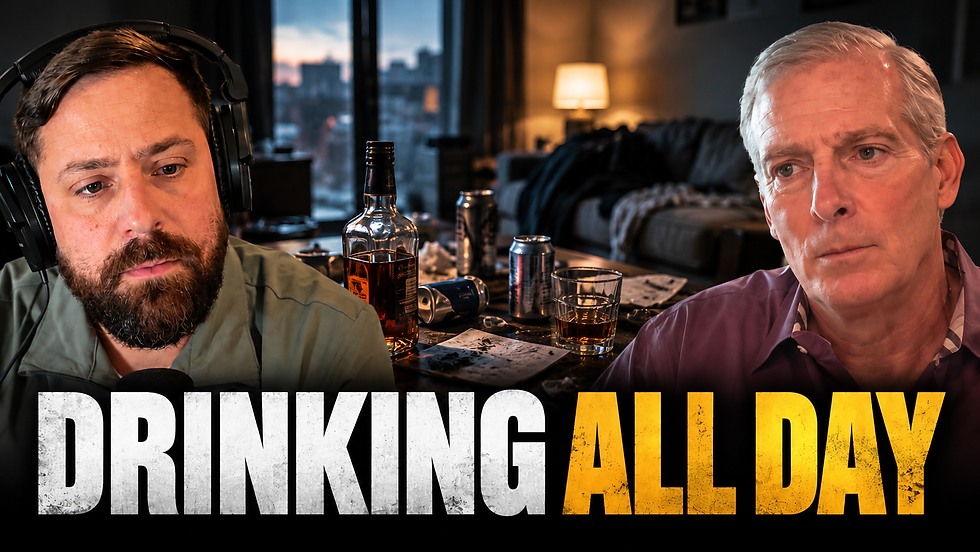
For about five years, Tom drank roughly 30 ounces of vodka a day, from the moment he woke up until he passed out. Almost nobody knew how bad it was. That was the whole point.
Tom is a longtime listener of the show. He reached out to Brad after hearing Jacob's episode, and he recorded his story days before his five-year sober date. This is what hidden, daily drinking looks like from the inside, and what finally got him out.
How Does Weekend Drinking Turn Into Daily Drinking?
Usually slowly, then all at once. Weekend drinking turns daily when alcohol stops being something you do for fun and becomes something you need to get through the day. Most people don't notice the line when they cross it.
Tom had a good childhood. Loving parents, three brothers, a solid home. His first real night of drinking came at 13 or 14, when his older brother showed up on New Year's Eve with their parents' liquor cabinet in a bag. Tom drank a lot of Crown Royal and had the time of his life.
He never said "never again." He couldn't wait to do it again.
It became a weekend thing. Then Friday through Sunday. Then Monday. By grade 12, he was drinking a six-pack in the school parking lot before a class presentation because standing up in front of people terrified him.
"There was a lot of things that alcohol did for me that I felt like I couldn't do for myself," Tom said.
After flunking out of college, he went to work in a golf and curling club kitchen. He stayed 13 years and worked his way up from dishwasher to executive sous chef. Work hard, party harder. When a new manager restructured the place and let him go, Tom fell apart.
"When things didn't go the way I thought they were going to, it was just complete breakdown," he said.
He noticed one thing even then. When the night ended for his friends, it didn't end for him. He always made sure he had enough at home to keep going.
What Does Hiding a Drinking Problem Actually Look Like?
It looks like a second full-time job. Hiding a drinking problem means constant planning: how much you have, where it's stashed, where to buy more without being noticed, and how to get rid of the empties. From the outside, everything looks fine.
Tom had a house, a new car, and a steady paycheque. Inside, he was exhausted.
Here's what his days actually looked like:
Morning drinking to stop the shakes. Not to get drunk. Just enough to take the edge off and get through to lunch, then a little more to get through to home.
A bottle in the glovebox. A 26er of vodka fit perfectly. After a heavy night, he'd top up the bottle at home so no one could tell.
Rotating liquor stores. Sarnia has four LCBOs. He hit a different one every day.
Hiding the recycling. Two blue boxes full of empty vodka bottles every other week. Sometimes he drove the empties away in garbage bags.
The cover slipped once. When an LCBO strike was threatened, Tom bought a whole case of vodka "just in case." Two weeks later, he told coworkers he had to run to the liquor store before meeting them. One of them stopped him: didn't you just buy a case?
"Once people started to find out, it was always that fear," Tom said. "If people know, then people are gonna make me do something about it. And that scared me the most."
The excuses that kept it going
Tom's go-to was his dad. His father died of a heart attack on New Year's Day when Tom was 19, and Tom was in the house. He's clear today that he was already well on his way before that. But back then, it was the excuse he reached for.
The other was comparison. There was always someone drinking more.
Brad pointed out the catch in that logic on the episode. We never compare ourselves to the guy who has two beers on a Saturday. We only measure against the person falling apart worse than we are.
Why a Fresh Start Didn't Fix Anything
Moving away rarely fixes a drinking problem, because the drinking comes with you. People in recovery call it the geographic cure, and it almost never works on its own.
By his mid-30s, Tom was throwing up bile in his backyard every morning, quietly, so no one would hear. He decided the problem was his surroundings. He quit the restaurant business, sold his house, and took a job at a pharmaceutical plant two and a half hours away. New city, new friends, new life.
It did the opposite. Nobody knew him. Nobody to answer to. A pile of money from the house sale.
"It was a free-for-all," he said.
The crash
Driving home from work one day on a rural highway, Tom had a seizure behind the wheel. He woke up in an ambulance with no memory of what happened. Two fractured vertebrae, a fractured knee, a concussion. Police later told him they'd needed the Jaws of Life to get him out, and they assumed whoever was in that car was dead.
It didn't slow him down. He couldn't wait to get home and drink, and he was excited about the painkiller prescription.
A week later, he had to give the police a statement. He promised himself no alcohol that morning. He doubled up on pills instead. When that didn't work, he allowed one drink. Then two. Then three.
"Next thing you know, I'm freaking lit on my way to the OPP office to explain to two cops that I wasn't drinking on my way home from work," Tom said.
After the crash, coworkers started smelling it on him. HR called him in almost weekly. He denied everything until they let him go. Out of money and out of options, he called his mom and told her there were layoffs. Could the family move in?
She said yes. Within a month, his mom, his wife, and his younger brother sat him down for an intervention. Tom called them all hypocrites and tried to walk out.
When the Body Forces the Decision
Heavy daily drinking eventually shows up in the body, whether or not you're ready to admit it. For Tom, it showed up as blood.
A couple of weeks after the intervention, he went to his usual spot in his mom's backyard to be sick. It wasn't bile anymore. It looked like coffee grounds. An hour later, it was bright red.
His first thought was how to cover it up. He Googled it. Everything said get to a hospital now, you might have a week to live. His next thought: how do I want to spend my last week?
For two days he kept hiding it, passing out around the house and losing control of his body. It ended when his mom's dog came in from the backyard covered in it. Tom told her everything. She drove him straight to emergency.
He spent five days in the ICU. He had his first blood transfusion. And he went through full alcohol withdrawal for the first time, hallucinations included. One morning he woke up handcuffed to the bed after fighting nurses and security while pulling out his IVs.
Stopping suddenly after long-term heavy drinking can be dangerous. Tom's withdrawal happened in an ICU for a reason. If you drink daily and want to stop, talk to a doctor about medical detox first.
"I choose this bottle over her every time"
On the drive home from the hospital, Tom asked his mom to stop at the liquor store. She didn't. So when she left to fill his prescriptions, he went straight to the wine in her laundry room.
That's where his 14-year-old daughter found him. She burst into tears.
"I'm supposed to care about this person more than anything else on the planet," Tom said, "and I choose this bottle over her every time. Like, what the hell is wrong with me?"
Even that didn't stop him. Over the next few weeks his body swelled with fluid until he looked pregnant. The bleeding came from damaged veins in his esophagus. He'd lost about eight teeth to years of throwing up stomach acid.
When the bleeding started again, he went back to the same ER, where staff remembered him by name. This time a doctor gave him the diagnosis: end-stage cirrhosis of the liver.
"You got a decision to make," she told him. "Either you stop and you have a chance, or you don't and you'll probably be dead in a week or two."
A worker from Ryan's House, a 30-day sober living program run with the hospital, came to talk to him. Tom thanked her politely and said it wasn't for him. But his wife had a plan to leave, and his welcome at his mom's was running out. He agreed to go, mostly to prove he was too far gone.
There was a 40-day wait for a bed. Tom white-knuckled it on his mom's couch, running on fear. He had his last drink about two weeks before he got the call. He hasn't had one since.
What Most People Get Wrong About Quitting
Most people who drink in secret aren't waiting to hit bottom. They're waiting for proof they have a problem. Tom's story shows how long you can wait.
"I'm not that bad yet." For years Tom had no DUI, no arrests, no hospital stays, and he went to work every day. So he decided he was fine. Then he got all of it, and it still wasn't enough to stop him. Consequences alone rarely do.
"I'll handle this myself." Tom wanted to quit without anyone knowing. "Anytime I had tried, I couldn't even make a day," he said. Secrecy protects the drinking, not you.
"A fresh start will fix it." New city, new job, new friends. He drank more, not less.
"I just need to learn to manage it." Even walking into Ryan's House, Tom's real goal was to learn to drink normally. That goal changed only after he got around people who had stopped.
"I can't have fun without it." Brad called alcohol the gatekeeper: concerts, barbecues, games, all behind the drink. Looking back, he said, the fun was gone a long time ago.
Brad added one more on the episode. Part of what keeps people stuck is fear of what happens if quitting actually works. Drinking is predictable. A life without it is unknown.
What Actually Worked for Tom
What turned things around for Tom was connection. Not willpower, not a new city. People who had been where he was, saying it out loud.
Hearing someone else say it
Tom was the 12th person in a 12-bed house, and he had no idea how to talk to anyone sober. He kept to himself. Then volunteers from recovery fellowships started coming in each night to share their stories.
"Everything he was saying was like how I felt my whole life," Tom said of one speaker, "but I never heard anyone else say it out loud before."
That was his first glimpse of hope. The speaker left him with one piece of advice: if you're here for 30 days, make the most of it. So Tom did. He joined everything. He rediscovered cooking and made Christmas turkey dinner for the whole house.
Going to a meeting the day he got out
His new sponsor told him to hit a meeting the same day he left, because if he didn't go that day, he wouldn't go. He walked into a room of 40 strangers, scared. A man hugged him at the door and introduced himself. That man is one of his best friends today.
"Everyone was so happy," Tom said. "It was like, holy cow. Yeah, man, I want that."
Showing up for everything
Tom did 90 meetings in 90 days. If people went for coffee, he invited himself. If people went bowling, he went, even though he hates bowling.
"Those connections you make and those relationships, that's what got me through," he said. "And that's what keeps me clean today."
He also found that life without drinking was cheaper and more fun than he expected. When you're not spending everything on alcohol, you can afford to go do things.
Finishing something
Tom worked the 12 steps and finished before his two-year mark. Asked if he had a spiritual awakening, he said he wasn't sure. But it was the first thing in years he'd seen through from start to finish, and that gave him real confidence.
Today he sits on the committee that brings speakers into Ryan's House. He makes the schedule, and he goes in to share his own story.
Tom's path ran through a 12-step fellowship. Yours might look different. The common thread in almost every story on this show is the same: people who stay sober stop doing it alone.
Life Five Years Later
Tom is coming up on five years without a drink. His wife was excited for him to record this episode.
"Our relationship's never been better," he said. "When I got clean, it was almost like starting the relationship over again. It felt fresh, like we were kids again."
His daughter is doing well and supports his recovery. His mom is proud. Tom calls it a living amends: the people who love him don't have to worry about him anymore.
He doesn't take it for granted. Alcohol is at every restaurant, gas station, and corner store. He's watched people drift away from recovery once life gets good and busy.
"What I did yesterday doesn't keep me clean for tomorrow," he said, repeating something he heard at a meeting.
Brad agreed. Plenty of people relapse not because life falls apart, but because it's going well and they decide they're past needing the things that got them there.
From Hiding Everything to Telling Everyone
For most of his life, Tom's biggest fear was someone finding out. Today he's sharing his whole story on a podcast, breaking his own anonymity to do it.
"If this is gonna help even one person, then it's worth doing," he said.
If you're hiding bottles, topping up the vodka, or doing math every night on whether you have enough for tomorrow, you're not the only one. Tom lived it for years. He also proves it doesn't have to end the way the doctor predicted.
Listen to Tom's full story on YouTube. If you're tired of trying to quit alone, the Sober Motivation app has daily peer support calls with people who get it. Come say hi on a call.

Comments