Secret Drinking: How Corey Hid It, Why Nobody Knew, and How She Quit Without a Rock Bottom
In 2021, Corey figured out that her husband couldn't see the kitchen from the living room. That was all it took.
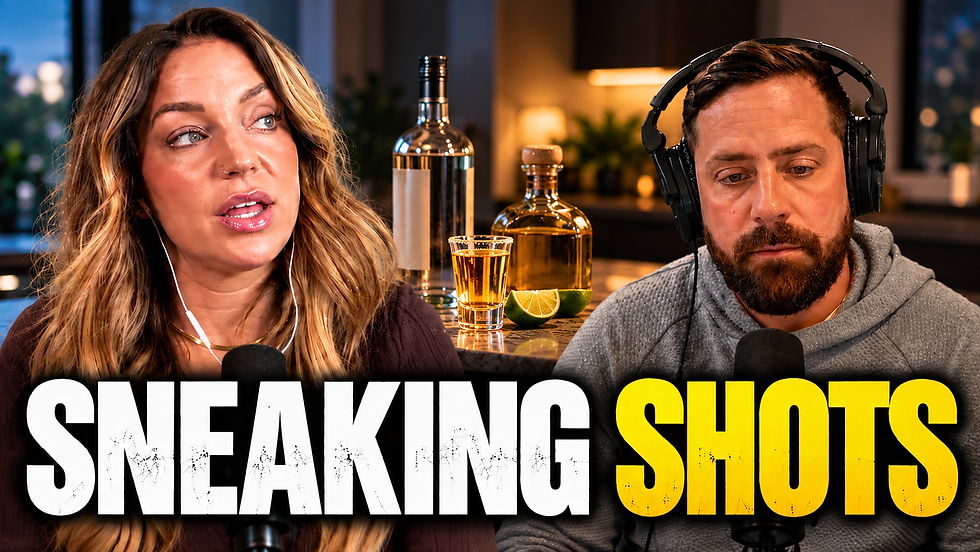
"I can sneak a shot while I'm in the kitchen 'cause he can't see me in the kitchen," she said on the Sober Motivation Podcast. "I don't think I've really ever talked about this."
From the outside, Corey had it together. Wife, new mom, general manager of a busy bar and restaurant in Des Moines, the person everyone could count on. On the inside, she was sneaking shots in the back room, lying to her doctor, and carrying a level of shame almost nobody knew about. If you're hiding your drinking right now, her story will feel uncomfortably familiar. It also ends somewhere good.
What is secret drinking?
Secret drinking is drinking you deliberately hide from the people around you: sneaking drinks, stashing bottles, or drinking before or after social events so no one sees how much you actually have. It's one of the clearest signs that drinking has moved from habit to problem, because hiding it means some part of you already knows.
Corey knew. She just couldn't say it out loud yet.
How did Corey's drinking start?
Corey grew up in West Des Moines, Iowa, in what she calls "a perfect upbringing." Dance team, close family, and parents who had a Jack and Coke or a glass of wine on special occasions, and that was it. She tried alcohol at high school parties, but it didn't grab her.
What changed things was the bar industry. At 18, fresh out of high school, she took a job at a popular Des Moines nightclub. Her mom had a heart attack that summer, so Corey skipped college to help care for her, working 9 p.m. to 5 a.m. and going to the hospital after.
The nightclub introduced her to shots. Then came the weekly cycle: Wednesday dollar drinks, Birthday Thursdays, Friday and Saturday downtown, Sunday Funday, two nights off, repeat. "That just rolled every single week," she said.
She made good money, knew every bouncer and bartender in town, and felt a step ahead of everyone her age. "I could handle it because I could also afford it."
Why is the bar and restaurant industry so hard on drinkers?
People who work in food service and hospitality have some of the highest rates of alcohol and drug problems of any industry. A SAMHSA report found accommodation and food service workers had the highest rate of substance use disorder of any industry studied (16.9%) and one of the highest rates of heavy drinking (11.8%).
It's not hard to see why. Alcohol is the product, the reward, the social glue, and the way you unwind at 2 a.m. when nobody else is awake. Corey put it plainly: "In this bar restaurant culture, it's so normal to have a shot on a Tuesday afternoon at 2:00. I don't care who says it's not. If you're in that life, you know exactly what I'm talking about."
When everyone around you drinks the same way, there's no mirror. You just look normal.
What does high-functioning drinking actually look like?
A high-functioning alcoholic keeps up with work, family, and responsibilities while drinking in a way that quietly damages their health and mental state. The functioning is the camouflage. It's also what keeps people from getting help, because nothing looks broken.
For Corey, it was two or three shots a day, minimum. One in the morning before a double. One with a regular she hadn't seen in weeks. One when someone had a birthday or a promotion or a bad day. "There you are. You're already four shots in on a day you didn't even think you were gonna drink."
She was never late and never missed a shift. She ran the social media, organized live trivia during COVID, and answered every call from her boss. She rarely felt hungover because her body was used to it.
What she did notice was calling her parents on the drive home, then telling them the same story the next day. "They would be like, 'Yeah, you told us that last night.'" She blamed 14-hour shifts. Looking back, she calls it what it was: browning out.
Brad described why functioning matters so much to people who drink like this. If you start showing up late or missing things, "we don't want anybody looking under the hood." Corey's response: "You just described it perfectly."
Why do people hide their drinking from the people who love them?
Most people hide their drinking because of shame and fear of what the truth will cost them. The better life looks on the outside, the harder it feels to admit what's happening on the inside.
By 2021, Corey had a lot on her plate. She had a baby in 2019 and got no real maternity leave (she was back at work five days after giving birth). She had postpartum struggles nobody addressed. And during COVID she lost close to 10 people among family, friends, and regulars in about nine months, including her husband's father and her own grandfather.
She was also married to a man everyone called the perfect guy. He barely drank. People told her she'd finally found her happy ending.
"How could I ask for help when everything seems so good?"
That's the trap. Corey felt like she was living two lives. "I felt kind of like I had imposter syndrome. I was trying to be something I wasn't, but no one else besides me knew what was happening on the inside."
She wasn't alone in that. Research from RAND found that heavy drinking days among women rose 41% in the early months of the pandemic compared with the year before. A lot of women were sneaking that kitchen shot.
What do elevated liver enzymes mean?
Elevated liver enzymes (such as ALT, AST, or GGT on a blood test) are a sign that liver cells are stressed or inflamed. Heavy or regular drinking is one of the most common causes, and levels often drop when drinking is reduced or stopped.
In 2021, back pain from scoliosis sent Corey to a chiropractor, who sent her to a doctor. The doctor asked if she'd been drinking a lot. Corey lied. Then the doctor looked her in the eye and said: "You are way too young to have elevated liver enzymes."
She was 29. "I thought that you had to be drinking a bottle of Jack once a day to have those types of issues." She linked liver problems with older regulars, not a young mom having a few shots a day.
That belief is common, and it's wrong. A study in The BMJ found that deaths from cirrhosis in the U.S. rose fastest among people aged 25 to 34, driven largely by alcohol. Here's what alcohol actually does to your liver, long before you feel anything.
Her follow-up numbers came back better, and she took it as a clean bill of health. But the seed was planted. "Every single time I took a shot, I was like, 'What is this doing to my liver?' I still took the shot, but I was thinking about it."
Can you drink while taking antidepressants?
Alcohol is a depressant, and drinking while on antidepressants can make depression and anxiety worse and make the medication less effective. Many people in this spot decide the medication isn't working when alcohol is what's undercutting it.
Corey started an antidepressant around the same time as the liver scare. She couldn't figure out why she didn't feel any better. "I had never put two and two together that you just can't take antidepressants and drink alcohol and expect to have a good outcome."
What happened when it finally caught up with her?
Halloween weekend, 2021. Corey was running two bars for the same company, working days at one and nights at the other, and drinking to keep going. She came home on a Friday night mentally checked out.
She told her husband she couldn't do it anymore and that she didn't want to be here anymore. He pulled her back inside. The next morning she texted her boss and quit, on the morning of an Iowa football game she was supposed to open for. Her husband returned her keys.
If you're having thoughts of not wanting to be here, please reach out. In the U.S. and Canada, you can call or text 988 any time.
Quitting the job wasn't quitting drinking. Not yet.
What is the sober curious phase, and does it help?
Being sober curious means questioning your drinking and trying cutbacks or breaks without committing to quit for good. For a lot of people, it's a messy but necessary step between "I think I have a problem" and "I'm done."
Corey spent two years there. She moved to a restaurant in an upscale hotel. She'd go 30 days without drinking, then 60 days off and 60 days on. She'd reward herself at someone's wedding. "I played this just back and forth, back and forth."
Then came her own wedding reception on December 22, 2022. That morning she got into a car accident in a snowstorm, and at the venue someone handed her a shot of tequila. "I got so drunk that day." She calls it one of her biggest regrets.
In early 2023, she left the restaurant industry completely, went to beauty school, and became an esthetician. She still drank sometimes, but less, partly because you can't lean over someone's face smelling like last night. She also started listening to the Sober Motivation Podcast and watching friends post their sober milestones.
"The sober curious phase is exhausting," she said. "But also, thank God I had it."
Do you need a rock bottom to quit drinking?
No. Many people quit without a dramatic final moment. They reach a point where they're tired of the cycle and decide to stop. Waiting for a rock bottom can mean waiting for something far worse than necessary.
Corey had plenty of moments that could have been rock bottoms. None of them was the last one. As Elisa's story shows, hitting rock bottom rarely makes people quit on its own.
On Sunday, December 10, 2023, she woke up after a pretty tame work party and decided. She'd been planning a sober 2024. Then she asked herself what was stopping her from starting now. The holidays? New Year's Eve?
"There was no rock bottom. There was no 'this happened, so I can't do it anymore.' I literally just woke up and said, 'I'm tired. I'm done.'"
She hasn't had a drink since.
What Most People Get Wrong About Secret Drinking
"If I'm functioning, I'm fine." Corey never missed a shift and had elevated liver enzymes at 29. Functioning is not the same as healthy.
"Liver damage only happens to old heavy drinkers." Daily shots add up, and cirrhosis deaths are rising fastest among young adults.
"Everyone around me drinks like this." Corey used her customers as proof she was normal. "If they can do it, so can I." But they were sipping bottomless mimosas, not taking straight tequila at 10 a.m. in the back room.
"People will think less of me." When Corey finally posted about being two years sober, her phone filled up. "The amount of people that literally texted me and said, 'I never knew. I never knew.'" The judgment she feared mostly didn't show up.
"I'm the only one." A year after her own worst stretch, an uncle died from alcoholism. She had no idea how close it was to home. "Could you imagine if I would've talked to some of my cousins?"
What Actually Works
Here's what got Corey through her first year and beyond. None of it is complicated.
Count to Sunday. She quit on a Sunday, so her whole goal was the next Sunday. Then the next one. "Just get to seven days and then restart that."
Keep the circle small at first. Only her husband and her best friend knew, which took the pressure off. She told her parents at 30 days. Her dad cried.
Make it a trial, not a life sentence. She was going for one sober year. "It doesn't have to be forever. For some people, it just needs to be for a little bit." Now she can't imagine going back.
Replace the ritual. After her second daughter was born in 2024, she went to the gym every time she wanted a drink. A 5K turned into a 10K, which turned into a half-marathon goal.
Change the environment until you're strong enough to handle it. She left the industry completely in 2023. In 2025 she went back, and now she bartends a few shifts with her husband for what they call "Disney money," fully sober.
Pay attention to the thought. "If it's even just a thought in your head, if it's crossed your mind, there's a reason it's crossed your mind."
Can you work in a bar and stay sober?
Yes, but usually not right away. Many people in recovery need distance from drinking environments first. Then they go back (if they want to) once their sobriety feels solid and they know their reasons.
Corey bartends now and loves it more than she ever did. When regulars who've seen her sober posts ask how she does it, she has a line ready:
"I had to retire. I was literally just too good at it."
They laugh. It's also true.
Life on the other side of hiding
Corey is more than 1,000 days sober. She does bridal makeup for big Des Moines weddings, works at a long-running spa, sits on a school gala committee, and appears on local news. None of it was on her radar in 2023.
What changed most isn't on a résumé. "Back then, if I saw you at Hy-Vee, I would've been like, 'Oh my God, Brad, so good to see you.' Now I'd be like, 'Brad, how are the kids?' Actually present and actually care about you."
She's honest that it hasn't been easy. "It's not 1,000 easy days." She still has anxiety. She still has the drinking dreams where she wakes up shaking, thinking she threw it all away. But she'll tell you that the way she feels now, compared with December 9th, is a whole other ballgame.
If you're sneaking the kitchen shot, you already know something's off. Hiding takes an enormous amount of energy. You don't need a rock bottom to stop spending it.
Hear Corey tell it in her own words. Listen to her full episode on the Sober Motivation Podcast. If her story hit close to home, you don't have to figure this out alone. The Sober Motivation app is full of people who've been exactly where you are.

Comments