David Chaney: The High-Functioning Alcoholic Nobody Saw Falling
By the time singer David Chaney walked into rehab, he weighed 100 pounds. People in his hometown assumed he was on cocaine. He had never touched it. It was alcohol, hidden in Listerine bottles and cologne bottles, scheduled around morning workouts so nobody would ever catch him slipping.
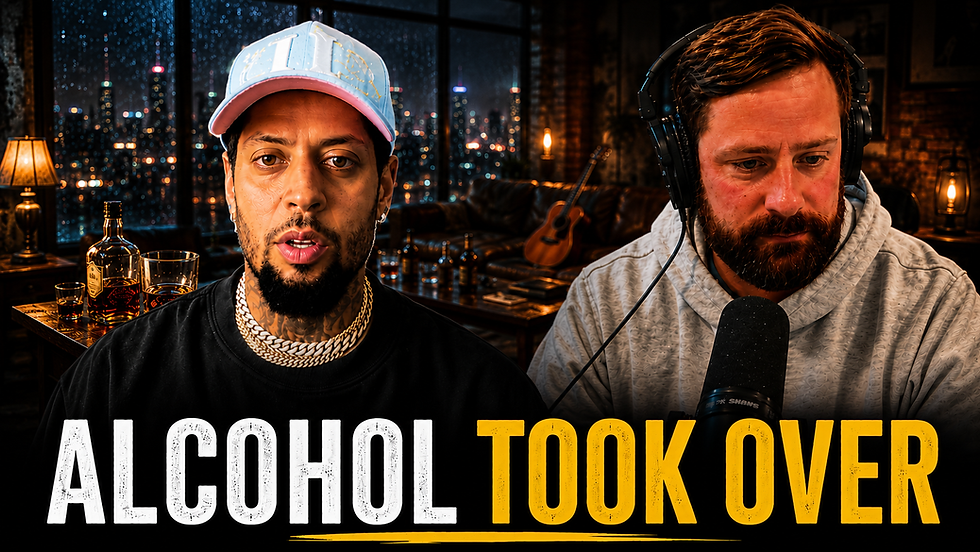
A high-functioning alcoholic is someone whose career, relationships, and public image stay intact, sometimes even thriving, while their drinking quietly progresses into addiction behind closed doors. David Chaney was one of the most extreme examples you will ever hear. He sang the official Coca-Cola anthem for the World Cup and performed the national anthem at Sunday Night Football in front of 80,000 people, all while drinking at a level that was slowly killing him.
On the Sober Motivation podcast, David told the full story for the first time: the grief that lit the fuse, the eight years of failed rehabs, and the moment that finally ended it. This is what his story can teach anyone who is hiding their drinking in plain sight.
Who Is David Chaney?
David Chaney is a recording artist who was adopted from Brazil at age two and raised outside Annapolis, Maryland, by Stan and Carolyn Chaney. He describes his childhood as "nothing but love": dirt bikes, crabbing, sports, and a father who never let a day pass without saying he loved him.
Music chose him early. He earned a four-year scholarship to Berklee in Boston, competed on The X Factor, landed a Coca-Cola deal, and recorded the official anthem for the World Cup, a full-circle moment that took him back to his birth country.
He also grew up around drinking. His father was an alcoholic, though David only ever saw the sweet side of him. Alcohol was simply part of the culture.
"You couldn't have paid me to think I was gonna have an issue with alcohol."
When Grief Opens the Door
David's drinking followed a slow, ordinary progression: college parties, a few drinks to unwind after work, a rising tolerance he barely noticed. What changed everything was loss.
In his late twenties, at the peak of his career, his mom was diagnosed with stage IV cancer. David remembers finishing a bottle in his car before he even heard the news, a moment he now calls the real birth of his addiction. His mom retired and died about a month and a half later, holding on just long enough to see him walk through the door after a 17-hour flight home from a tour stop in Asia.
Two years later, his dad died on Christmas Eve. David was 27 or 28, an only child, estranged from extended family, with no roadmap for that kind of grief.
"I just became friends with the thing that tried to kill me."
He also watched his father's own drinking spiral after his mom's death, carrying him upstairs at night, finding him surrounded by her photos in a dark kitchen. Those images haunted him, and raised a question he was not ready to answer: am I an alcoholic too?
If grief is tangled up in your own drinking, Mailinn's episode covers similar ground: Drinking to Numb Your Feelings: How Mailinn Survived End-Stage Alcoholism.
What a High-Functioning Alcoholic Actually Looks Like
The most valuable part of David's story is how specific he gets about the hiding. High-functioning addiction is not chaos. It is management. His system included:
Scheduling around the drinking. Meetings at 9 a.m., because by late afternoon he was "a different human."
Sweating it out. Daily gym sessions to burn off the night before so he could function.
The professional's discipline. Memorizing performances so thoroughly he could deliver them half asleep, or drunk.
Props and cover. Sunglasses in nearly every photo and interview. Alcohol decanted into Listerine and cologne bottles around the house.
A rotating loop. Never hitting the same bar too many days in a row, so no one could see the pattern.
The people around him even had a nickname for his reliability: "There he is, Mr. Show Up." Every time.
That reliability is exactly why nobody intervened. As David puts it, some addicts function at a very high level, and the better the performance, the longer the addiction gets to grow. His wife saw the truth behind closed doors. At one point she put a tracker on his car. He was so far gone he did not know.
This pattern shows up across recovery stories, including She Was a High Functioning Alcoholic. She Never Got a DUI. The absence of visible consequences is not the absence of a problem.
The Invisible Line Between Abuse and Addiction
David and his wife have a name for the moment drinking stops being a habit and becomes a dependency: the invisible line.
"Only you know when you cross over from abuse to really addiction. And you have to go back and really think where that threshold is crossed."
For David, the line was the 48 hours after learning his mom had two weeks to live, when he drank more than he ever had and kept working anyway. Nobody else saw it happen. That is what makes the line invisible: it is crossed privately, long before the public consequences arrive.
Why Rehab Didn't Work the First Seven Times
David is open about having been to rehab "a million times." He had stretches of sobriety: four and a half months in Pittsburgh, 40 days around an ibogaine retreat in Costa Rica. Each time, ego pulled him back.
The most striking example: months into sobriety, he was invited to sing the national anthem at Sunday Night Football. Minutes before going on, he took shots at a bar in the stadium hallway, then delivered one of the best performances of his life. The euphoria afterward launched his darkest relapse.
"I wasn't supposed to stop until it was my time to stop. I'm the type of person, sometimes I have to touch the burner 20 times faster than somebody else."
If you have restarted more times than you can count, that pattern does not make you hopeless. It makes you normal. Jess got sober after 17 trips to detox and treatment, and her story is worth your time: Relapse After Rehab: How Jess Got Sober After 17 Trips to Detox and Treatment.
The Night It Almost Ended
There is a chapter of David's story he tells quietly, and we will keep it that way here. At his lowest point, deep in grief and drinking, he made a plan to end his life and drove to his parents' grave site to say goodbye. When he pulled into the cemetery, his childhood best friend, the first person he ever met in America, happened to be standing there. They cried for a long time. It was the first time David said out loud, "I think I have a serious problem. I think I need to go to rehab."
If you are struggling with thoughts like these, you do not have to white-knuckle them alone. In the US, you can call or text 988 at any time.
What Finally Worked
David's turning point came at 39, after what he describes as everything hitting at once: handcuffs, jail, a DUI, and a marriage on the brink. He broke down in Atlanta, fell to his knees, and never looked back.
"I had to crash out to cash in. It's that simple."
But the crash was only the start. What kept him sober, now about a year and a half, was rebuilding his life around the old recovery cliche he says could not be more true: people, places, things.
He moved. Leaving Pittsburgh, a drinking town where the weather fed his depression, for Charlotte, North Carolina. He calls it the smartest thing he has done.
He changed his people. Different circle, different expectations, no more rooms where his addiction was an asset to someone else.
He mapped his drinking window. David noticed he drank hardest between noon and 3 p.m., so he deliberately filled that window, mostly with golf, until the pattern broke.
He found 15 to 30 minutes a day that fills him up. The gym, golf, music. His advice to anyone: find your version, however small.
He put the obsession somewhere useful. The same obsessive drive that fueled his addiction now fuels his purpose. He released his first sober single, "Fake News," and discovered he could make music without a cup waiting between takes.
The scoreboard changed too. Success used to be stages and streams. Now it is his wife leaving for ten hours and saying "you've got the kids, right?" without a flicker of doubt. It is the 11-year-old son he adopted, who watched the worst of it, calling his dad a fighter. It is a 20-month-old who will never meet the old version of him.
"Alcohol is a slow death, point-blank, period. It will take the soul, it will take the man, it will take the woman, it will take the family, it will take the money. It will drain you to nothing."
What David Chaney's Story Teaches
David Chaney's story proves that competence is not evidence of control. He performed for 80,000 people while dying at 96 pounds. If your drinking has a schedule, a system, and a cover story, the performance is not a reason to wait. It is the warning sign.
His story also proves the other side: even after eight years of failed rehabs, grief that would level anyone, and a night he did not plan to survive, it turned. He does not think about alcohol anymore. He calls that the greatest blessing of his life.
Hear the whole conversation, including the parts this post could not hold, on the Sober Motivation podcast. And if David's stretch of starting over sounds like where you are, the Sober Motivation app has 60 monthly support calls and a community that will not grade you on streaks. Start at sobermotivation.com.
Frequently Asked Questions
Who is David Chaney?
David Chaney is an American singer, adopted from Brazil and raised in Maryland, known for recording the official Coca-Cola anthem for the World Cup and performing the national anthem at Sunday Night Football. He shared his recovery from alcohol addiction, now about a year and a half sober, on the Sober Motivation podcast.
What is a high-functioning alcoholic?
A high-functioning alcoholic is someone who maintains their career, relationships, and outward appearance while privately dependent on alcohol. As David Chaney's story shows, high performance can hide addiction for years, because reliability and success make the people around them dismiss the warning signs.
Can you be an alcoholic without visible consequences?
Yes. David Chaney performed at an elite level for years while drinking heavily every day. Consequences like a DUI or job loss often arrive late in the progression. Warning signs like hiding bottles, scheduling life around drinking, and rising tolerance usually come first.
What is the "invisible line" in addiction?
The invisible line is David Chaney's term for the private moment when alcohol abuse becomes addiction. Only the drinker knows when it was crossed, usually during a period of crisis or grief, and usually long before anyone else notices a problem.
Does relapsing mean recovery has failed?
No. David Chaney went through roughly eight years of failed rehab attempts and multiple relapses before getting sober. Relapse is a common part of the progression toward lasting sobriety, which is why finding support that lets you start again without shame matters. (General information; not medical advice.)


Comments