He Quit Drinking Without a Rock Bottom. Here's What the First Year Really Looked Like.
Updated: 1 day ago
Jon Gustin didn't get a DUI. He didn't lose his job. Nobody staged an intervention. He just looked at his two kids, looked at his drinking, and decided he wasn't willing to find out what would happen if he kept going. Quitting drinking without a rock bottom is more common than most people think, but it rarely gets talked about because the story doesn't have the dramatic turning point we've been conditioned to expect.
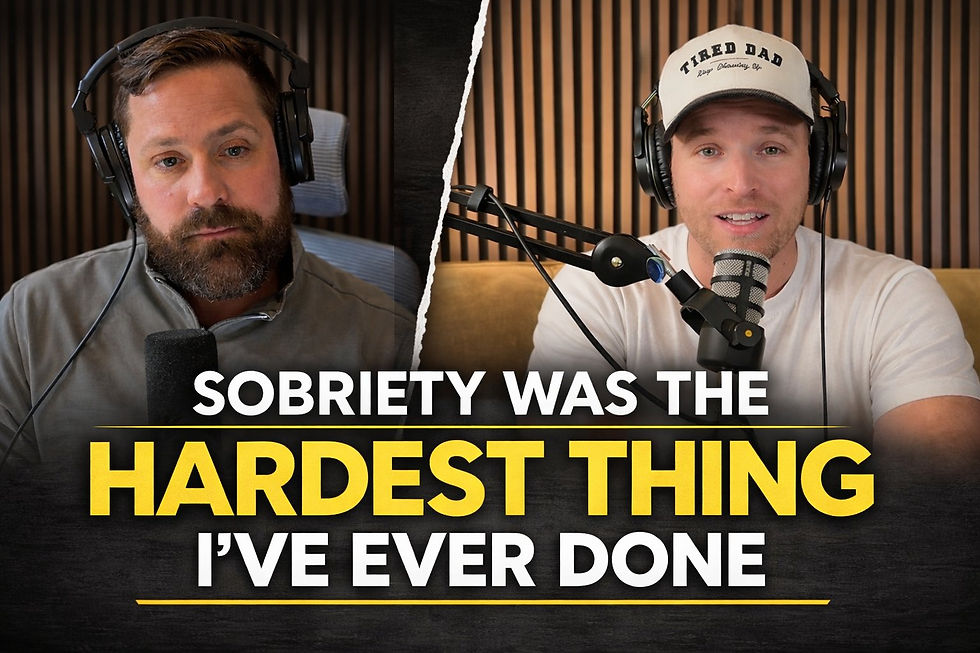
Quitting drinking without hitting rock bottom means making the decision to stop not because everything fell apart, but because you can see clearly enough to know that it will if you don't change course. On the Sober Motivation Podcast, Jon, known online as The Tired Dad to over two million followers, came back for a follow-up conversation three years into sobriety to share what actually happened after he quit. Spoiler: the first year was one of the hardest of his life.
Why Moderation Never Worked
Jon's relationship with substances started at 13. He took Adderall for the first time and remembers thinking, "I have to feel like this for the rest of my life." His first real experience getting drunk came around ninth grade, and the effect was the same: this fixes everything.
For the next decade, he used substances to mask his problems, manage social anxiety, handle stress, and get through decisions. He did hardcore drugs through high school and college, stopped those in his late twenties, but alcohol never went away.
"I knew I was never gonna have a good relationship with alcohol. It was never gonna get better. I was never gonna be a casual drinker. I was never gonna be the one drink guy. It was not gonna happen."
He tried. He quit for a month, then two months, then six months once. Every time, he told himself the break would "reset" him and he could go back to drinking normally. Every time, he made up for lost time the moment he started again.
Why moderation doesn't work for some people comes down to brain wiring. As Jon described it, his wife could have one drink, feel a little off, and decide she didn't want another. Jon's brain did the opposite: the moment something made him feel good, he obsessed over how to feel even better and how to keep that feeling going indefinitely. He would game-plan his drinking days in advance, calculating when and how much. That kind of preoccupation with alcohol is not something you can moderate your way out of.
If you've been trying to control your drinking and finding that the breaks only make the binges bigger, you're not alone. Read about what happened when one man tried for 25 years to manage his drinking before finally seeing the problem
Fatherhood Put a Mirror Up to Everything
The turning point wasn't a single event. It was becoming a father.
When his daughter was born in 2016, Jon described it as having a mirror held up to his entire life. All the things he had been avoiding, masking, and running from were suddenly impossible to ignore because there was now a small person watching everything he did.
By 2020, his drinking had escalated. He was drinking before noon. He was planning not to drink, then crushing 12 White Claws in a sitting. He was losing control of his own decision-making, and he knew it.
"I feared that I wasn't gonna be making my decisions anymore, and I was gonna become so dependent that it would've been too late for me to even make that decision to stop drinking."
His grandfather on his mother's side died of alcoholism at 64. Jon never met him. When he asked family members when they first noticed the problem, no one could pinpoint it. They just remembered casual beers turning into handles of vodka over time. Jon saw himself on that same path.
He also shared something he said he had never disclosed publicly before: after his daughter was born via C-section, his wife was prescribed Vicodin. She didn't like how it made her feel. Jon, who had a history with pills from his younger years, started sneaking them. One night, he combined hard liquor with multiple pills and doesn't remember falling asleep. He woke up terrified.
That wasn't his "rock bottom" in the traditional sense. Nobody knew. He kept it to himself. But it was one of the accumulating moments that made him realize how dangerous his trajectory had become.
You Don't Need a Rock Bottom to Have a Real Problem
One of the most important things Jon emphasized is that not every sobriety story needs a catastrophic event to be valid.
"Not everybody has to be a full-blown heroin addict or go to jail, get a DUI. It doesn't have to be this crazy story. It could literally be, I drink too much wine every night and I'm using it to run away from my problems."
This message matters because the myth of rock bottom keeps a lot of people stuck. If you're waiting for something terrible enough to justify quitting, you might be waiting until it's too late. Jon compared it to a cucumber turning into a pickle: nobody can tell you the exact moment it happens, but once it does, there's no going back.
People who don't have a drinking problem don't wrestle with it. They don't try to moderate. They don't go to the store and only buy two because they're trying to limit themselves. If you're already in that cycle of trying to control something, the control is already gone.
If that resonates, you might also connect with this story: I Never Hit Rock Bottom, But Alcohol Was Destroying Me From the Inside
The First Year of Sobriety Was Brutal (And That's Normal)
This is where Jon's story takes a turn that most sobriety content on social media skips over entirely. The first year of sobriety was not a triumphant rebirth. It was the hardest year of his life.
"That first year of being sober wasn't a great year for me because I was dealing with so much of that stuff that I haven't dealt with since I was 13 years old."
He had gone through puberty, high school, his twenties, and into his thirties masking every emotion with substances. When he removed the mask, everything surfaced at once: how he handled stress, relationships, decision-making, emotions he had never learned to process. He had his first panic attack. He had to relearn how to exist as a human being without a chemical buffer.
The first year of sobriety is hard because you are not just removing alcohol. You are confronting decades of unprocessed life. Jon described it as "raw-dogging life," and when you get sober in your mid-to-late thirties, the stakes are higher. There are mortgages, careers, marriages, and children. The stress doesn't pause while you figure yourself out.
This is the part that can make people quit quitting. If sobriety is supposed to make your life better, but it feels worse at first because the bandaid is gone, it's tempting to think, "What's the point?" Jon wants people to know that the difficulty is the process working, not a sign that it's failing.
Three Years In: The Tools He Never Had Before
Now over three years sober at 40 years old, Jon says he has tools he never had at any point in his life. He has learned about his ego, his triggers, his childhood wounds, how he talks to people, and how he handles stress.
Some days are still hard. But the hard days now come with clarity and capability that didn't exist before.
"Some days are really hard. And then some days are like, wow, this would've never happened if I didn't get sober. I would've never learned this stuff."
He is careful to distinguish between what sobriety actually offers and what social media sometimes sells it as. Sobriety didn't turn him into a six-figure entrepreneur or a picture of constant positivity. It gave him the ability to be present, to grow, and to stop running from himself. His goal was never business success. It was to become a better dad, a better person, and to finally deal with the things he'd been carrying since childhood.
The Social Media Comparison Trap
Jon had strong words about comparing your sobriety to what you see online. Social media isn't just a highlight reel, he said. It's an exaggerated reel. Dramatization is part of the platform.
Seeing someone go from prison to a seven-figure business can make your own quiet, grinding recovery feel inadequate. But that narrative isn't what sobriety is for most people. And you can be an alcoholic and build a successful business. Substances and success are not mutually exclusive. The real question is whether you're at peace with yourself.
Jon's advice: stop scrolling. The volume of information is overwhelming, and most of it will never make you feel good about where you are. Find what works for you. Nobody can do your sobriety for you.
Breaking Generational Cycles Through Fatherhood
Jon's upcoming book, The Tired Dad: 100 Reflections on Showing Up for What Matters Most, is rooted in everything he went through as a father navigating addiction, recovery, and the desire to break the patterns he grew up with.
His own father, going through a divorce and personal struggles, didn't know how to handle Jon's behavior as a teenager. Jon doesn't blame him. He sees now that his dad was doing the best he could with what he had, just like his grandfather before him. But the cycle of unspoken pain, emotional distance, and unprocessed trauma trickled down through generations.
"Children are horrible listeners, but they're great imitators. They are a sponge to you on what you do, how you talk to them, how you supported them, how you believed in them."
Jon got sober early enough that his kids will never have memories of him drinking. That was deliberate. He didn't want to be the dad his children had to "figure out" later in life. He wanted to show them, not just tell them, that it's okay to be human, to make mistakes, and to ask for help.
The book isn't a parenting manual or a sobriety memoir. It's 100 short reflections, written to be read with a morning coffee, about showing up for what matters. It even includes a soundtrack playlist of the music that shaped his life and carried him through hard times.
The Tired Dad: 100 Reflections on Showing Up for What Matters Most by Jon Gustin is available for pre-order now on Amazon and wherever books are sold. You can follow Jon on social media at @TheTiredDad.
Quitting Drinking Without a Rock Bottom Is Still Quitting
If Jon's story proves anything, it's that you don't need to lose everything to earn the right to change your life. You don't need a dramatic moment to justify the decision. And you don't need the first year to feel amazing for it to be working.
What you need is honesty with yourself about where your relationship with alcohol is heading, and the willingness to choose differently before you no longer can.
"Most likely, your drinking's not just suddenly gonna get better on its own. It's just not how it works. It's usually the other way around."
Frequently Asked Questions
Can you quit drinking without hitting rock bottom?
Yes. Many people stop drinking not because of a catastrophic event, but because they recognize a pattern heading in a dangerous direction. Jon Gustin quit after years of escalating drinking, not because of a single incident, but because he saw where the trajectory was leading and chose to change course before it was too late.
Why is the first year of sobriety so hard?
The first year is difficult because removing alcohol forces you to confront emotions, stress responses, and coping patterns you may have been avoiding for years or decades. Without the chemical buffer, everything surfaces at once. Jon described having to relearn how to handle stress, relationships, and decision-making after masking them since age 13.
Why doesn't moderation work for some drinkers?
For some people, the brain responds to alcohol by obsessively seeking more. Rather than feeling satisfied after one drink, the brain fixates on maintaining and increasing the feeling. Jon described game-planning his drinking in advance, a sign that the relationship with alcohol had moved beyond casual use into compulsion.
How does fatherhood motivate sobriety?
Becoming a parent often forces a hard look at habits and behaviors. Jon described fatherhood as "putting a mirror up to your life," making it impossible to ignore the ways alcohol was undermining the kind of father and person he wanted to be. His family history of alcoholism added urgency to that realization.
What is The Tired Dad book about?
The Tired Dad: 100 Reflections on Showing Up for What Matters Most by Jon Gustin is a collection of 100 short, personal reflections on fatherhood, vulnerability, breaking generational cycles, and showing up authentically. It is not a parenting manual or sobriety book, but draws on Jon's experiences with addiction, recovery, and the desire to be a present father.
You don't have to do this alone. The Sober Motivation App has live sober meetings every day, a day counter, and a community that gets it. Download free on iPhone or Android.
Want more stories like this? Listen to the Sober Motivation Podcast.

Comments