10 Things to Say When Someone Offers You a Drink This Summer
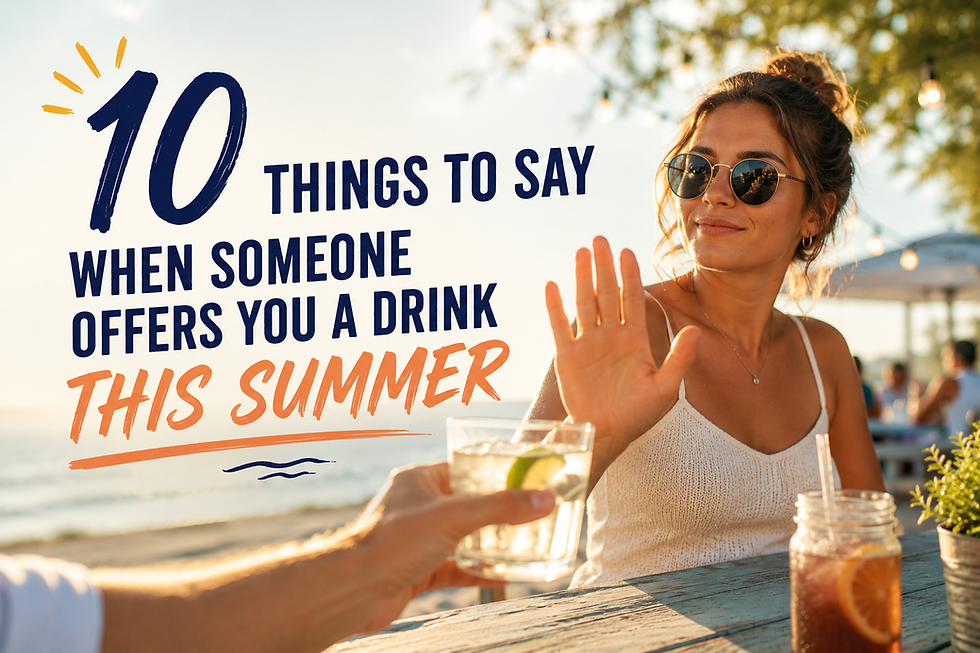
Summer is the season nobody warns you about when you stop drinking. The wedding invites stack up. The pool party group text fires off every weekend. The neighbor hands you a White Claw before you've even crossed onto the deck. Memorial Day, the 4th, your sister's barbecue, that one rooftop bar everyone insists on, all of it. If you've ever wondered what to say when someone offers you a drink, summer is when you find out you didn't have an answer ready.
You need one. Not a speech. Not a confession. A line. Ten of them, really, because different moments call for different scripts. The neighbor at the pool gets a different answer than your boss at the company outing, who gets a different answer than the aunt at the wedding who has been pushing wine on you since you were 19.
The framework below comes from real recovery communities, drink refusal research from the National Institute on Alcohol Abuse and Alcoholism (NIAAA), and what actually works in the wild. Each one includes the line, why it works, and when to use it. Pick the three or four that fit your voice and rehearse them out loud before the next event. You will be glad you did.
1. "I'm good with this, thanks." (And hold up what you're already holding.)
This is the simplest line on the list and the one that ends 80% of drink offers before they start. The trick is the prop. If your hand already has a sparkling water, a seltzer, an iced tea, or a mocktail in it, the offer dies on the table. People offer drinks to people whose hands are empty.
Why it works: You're not refusing. You're declining a second drink. Socially, those are very different.
When to use it: Backyard barbecues, weddings, pool parties, any open-bar event. Get a non-alcoholic drink in your hand within 60 seconds of arriving.
2. "Not tonight, I'm driving."
Universally accepted, almost never questioned. The designated driver excuse has been around so long it's basically a closed conversation. You don't have to explain further. You don't have to say it apologetically. You can deliver it with a shrug and a smile and the conversation moves on.
Why it works: It frames your no as responsible rather than personal. Most people will respect it because they're glad someone's driving.
When to use it: Anywhere alcohol is being offered and a car is involved. Works at weddings, BBQs, work events, dinners out.
3. "I'm taking a break from drinking right now."
This is the honest one. You're not telling your whole story. You're not saying "I'm an alcoholic." You're not explaining why. You're naming a current choice. People rarely push back on a stated intention if you say it with calm certainty.
Why it works: You've made a decision. You're sharing it. There's nothing to debate. The grounded tone is what does the work, not the words.
When to use it: With people who know you and might notice if you're not drinking. Family, close friends, coworkers who've had drinks with you before.
4. "Doesn't agree with my meds."
The medication line is one of the most respected refusals in any social setting because most people don't understand drug interactions and would rather not pry. You don't have to specify the medication. You don't have to be on medication for it to be true (in a sense, alcohol doesn't "agree" with anyone's recovery brain). But for many people in early sobriety, the line is literally accurate.
Why it works: Health excuses bypass the social pressure entirely. People back off out of respect.
When to use it: Aggressive or persistent offerers, work events where you don't want to discuss recovery, distant family members.
5. "I feel way better without it lately."
This one is honest, low-key, and surprisingly disarming. It's not a refusal, exactly. It's a self-report. Other people don't argue with how you feel, and many will quietly wish they could say the same.
Why it works: You're not making them wrong for drinking. You're just telling them what's true for you. This often starts genuinely good conversations rather than awkward ones.
When to use it: Friends you trust, summer dinner parties, anywhere you're comfortable being a little real.
6. "I'd rather remember this."
Save this one for the big moments. The wedding toast. The 4th of July fireworks. Your best friend's 40th. There's something about the line "I'd rather remember this" that lands emotionally with almost everyone, including people who drink heavily. It reframes sobriety as presence, not deprivation.
Why it works: It taps into something people feel but rarely say out loud. Almost everyone has lost a memory to a night of drinking. Naming the alternative makes them quietly proud of you.
When to use it: Weddings, milestone birthdays, vacations, beach trips, anywhere the moment itself is the point.
7. "I'm in." (Said while raising your seltzer for the toast.)
You don't have to opt out of the moment to opt out of the drink. When the toast goes up at the rehearsal dinner, raise your glass of whatever you're drinking and say "I'm in." Clinking glasses with water is fine. Nobody at a wedding has ever audited what was in someone else's flute.
Why it works: You're participating fully. The drink is a detail. The connection is the point, and you're not skipping it.
When to use it: Toasts, group cheers, summer cookout traditions, any moment that's about the shared experience rather than the actual drink.
8. "No thanks, I'm good." (Said calmly every time it comes up.)
This is the broken record technique, and it's the most underrated tool on this list. When someone keeps pushing (the pushy uncle, the boss who keeps refilling your glass, the friend who thinks they're being generous), you say the same six words, every time, in the same calm tone.
"Want a beer?" "No thanks, I'm good." "Come on, just one." "No thanks, I'm good." "You sure?" "Yep, I'm good."
After three rounds, almost every pusher gives up. They're looking for a reason to argue with, and you're not giving them one.
Why it works: No new information, no new excuse, no shift in tone. There's nothing for them to grab onto. The repetition signals you're not negotiating.
When to use it: With anyone who didn't accept the first no. Especially useful at family events.
9. "I'm doing a sober summer."
This one didn't exist five years ago. Now it's everywhere. A sober summer (or alcohol-free summer, or AF summer) has become a recognized thing, similar to Dry January. The phrase gives you cover without revealing anything else. The person hearing it can put it in the bucket of trendy wellness experiments and move on.
If your first sober summer happens to be your first sober anything, that's fine. The line still works. For more on navigating this specific stretch of time, the post How to Get Through Your First Sober Summer Without Feeling Like You're Missing Out breaks the season down.
Why it works: Sober summer is now culturally recognized. It signals "intentional" not "broken."
When to use it: Acquaintances, neighbors, coworkers at the company picnic, anyone you don't want to have a deeper conversation with.
10. "Tell me about you, what have you been up to?"
The full pivot. Someone asks if you want a drink, you decline briefly, and then you immediately redirect the conversation to them. People love talking about themselves. Within 15 seconds they will have forgotten they ever offered.
"Want a beer?" "No thanks, I'm good. What's new with you, how's the summer been?"
Why it works: It moves the social spotlight off your drink and onto them. The original offer disappears into the next topic.
When to use it: Anywhere. This is the universal escape hatch when you sense the conversation is about to get awkward.
What to Do When the Line Doesn't Work
About 90% of drink offers end after one of the lines above. The other 10% involve someone who is either drunk, deeply uncomfortable with your sobriety for their own reasons, or just genuinely pushy. Three things help in that moment.
First, you do not owe anyone an explanation. You can keep your reason for not drinking entirely private, forever, and that is your right. Second, if someone won't drop it after three calm refusals, give yourself permission to physically leave the conversation. Walk to the bathroom. Go say hi to someone across the room. Step outside. The exit is always available. Third, anxiety often spikes in these exact moments because your nervous system is already on edge. If you're newer to sobriety and these encounters leave you rattled, the post Hangxiety: Why You Feel So Anxious the Day After Drinking explains why and what helps.
The One Rule That Holds All of These Together
The words matter less than the tone. A nervous, apologetic "no" invites pushback. A calm, neutral "no" rarely does. Practice your top three lines out loud, in the mirror or in the car, before the next event. Hear yourself say them. Notice how it feels in your body when you sound certain. That confidence is the actual product. The script is just the delivery mechanism.
You don't have to dread the summer. You just need a few sentences in your back pocket and a non-alcoholic drink in your hand. The first event is the hardest. By the third one, the lines come automatically and you stop thinking about drinking at all. That's when the season starts to actually feel like yours.
Frequently Asked Questions
What's the best thing to say when someone offers you a drink at a party?
The most effective response is short, calm, and confident. "I'm good with this, thanks" while holding up a non-alcoholic drink ends most offers immediately. The key is having a drink already in your hand and delivering the line without apology or over-explanation. You do not owe anyone a reason for not drinking.
How do I refuse a drink at a wedding without making it awkward?
Use one of three approaches: hold a non-alcoholic drink the entire evening so people stop offering, say "I'm driving" or "I'd rather remember this," and participate fully in toasts by clinking your glass like everyone else. Weddings are easier than people expect when you have a plan and a prop drink in hand.
What do I say at a work event without telling everyone I'm sober?
Stick to neutral, professional lines like "I'm not drinking tonight," "I'm driving," or "I'm doing a sober summer." You can also order a club soda with lime, which is visually indistinguishable from a vodka soda and ends the question before it starts. You are not obligated to share your sobriety with coworkers unless you want to.
What if someone keeps pushing me after I say no?
Use the broken record technique: repeat the same calm, brief refusal every time, without offering new reasons. "No thanks, I'm good" works on a loop. Most pushers give up after three rounds because you're not giving them new material to argue with. If they still won't stop, you have full permission to leave the conversation.
Why is summer harder than other seasons when you're not drinking?
Summer concentrates drinking events into a small window: weddings, holiday weekends (Memorial Day, 4th of July, Labor Day), pool parties, vacations, patios, and barbecues. The cultural script is that summer equals drinking. Having pre-rehearsed responses for these specific scenarios reduces decision fatigue and makes saying no automatic instead of stressful.
Should I tell people I'm in recovery or keep it private?
That is entirely your choice and can change over time. Many people in early sobriety keep it private with acquaintances and coworkers and reserve disclosure for close friends and family. Others find it freeing to be open about it. There is no right answer. The point is that the decision is yours, not the person offering the drink.
Make Summer Yours
You don't have to skip the season to stay sober. You just need a few words, a non-alcoholic drink in your hand, and a community to land back into when the day is over. The Sober Motivation app hosts two virtual meetings a day, so if a wedding or barbecue rattles you, there's a room full of people who get it waiting on the other side. Download the app, join the meeting, and make this the summer you actually remember.


Comments