What Happens to Your Body When You Stop Drinking: A Day-by-Day Timeline (Day 1 to Year 1)
You took your last drink last night. Or you're planning to take it tonight. Either way, you're sitting somewhere right now Googling what's about to happen to you.
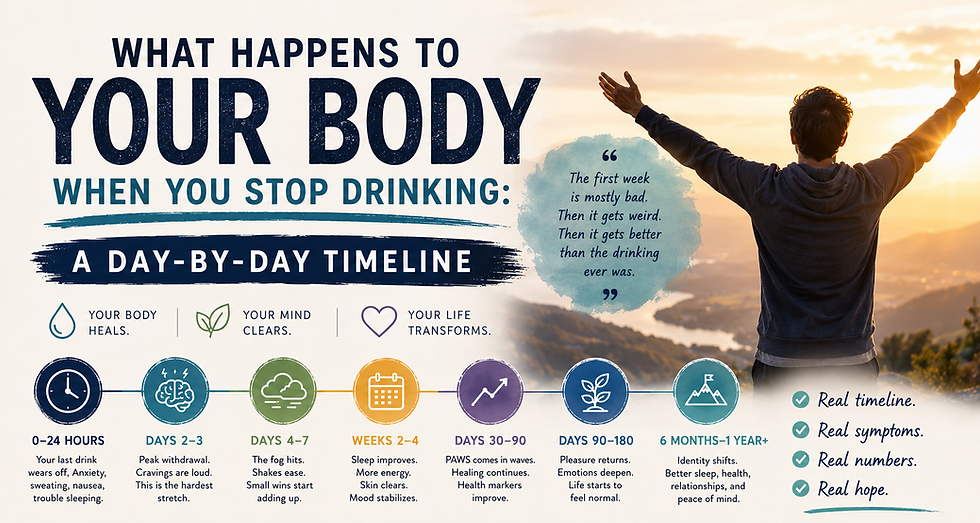
I'll tell you the truth, because nobody told me. The first week is mostly bad. Then it gets weird. Then it gets better than the drinking ever was.
This is what actually happens to your body when you stop drinking, hour by hour, day by day, all the way to a year. Real timeline, real symptoms, real numbers, written by people who lived through it and the doctors who tracked them.
A note before we start: if you drink heavily every day, talk to a doctor before you stop. Alcohol withdrawal is one of the few withdrawals that can kill you. Most people will be fine. Some people need medical supervision. Don't guess.
How Long Does It Take to Detox From Alcohol?
The acute physical detox takes about 7 to 10 days. The brain takes much longer to rebalance, usually 2 to 24 months depending on how much and how long you drank. Most people feel meaningfully better at day 30, noticeably good at day 90, and like a different human at one year.
That second timeline is the one nobody tells you about. It's also the one that matters.
The First 12 to 24 Hours: Your Last Drink Wears Off
Within 6 to 12 hours of your last drink, your blood alcohol drops to zero and your nervous system, which has been working overtime to compensate for the depressant, starts firing without resistance. That's why you feel buzzed in a bad way.
Most common symptoms: anxiety, mild shakes, sweating, nausea, headache, racing heart, trouble sleeping. If you're a moderate drinker, this is the worst of it.
If you've been drinking heavily and daily, this is when withdrawal can get medically serious. Watch for confusion, hallucinations, severe tremor, or seizures. Those are emergency-room signs. Don't wait it out.
Days 2 to 3: Peak Withdrawal
This is the hardest stretch for most people. Cortisol is high, sleep is broken, cravings are loud. Your brain is screaming for the chemical it has organized itself around, and it isn't subtle.
Common symptoms at days 2 to 3: insomnia, intrusive thoughts, irritability, sweating, vivid dreams when you do sleep, GI upset, low-grade dread.
The good news: this is when the cravings peak. After day 3, the physical part starts losing its grip even if your head doesn't believe it yet.
The bad news: this is when most people quit quitting. According to the NIAAA, around 72% of people who try to stop drinking relapse in the first 90 days, and a big chunk of those happen in the first 72 hours. If you can ride out three days, you've already done what most people don't.
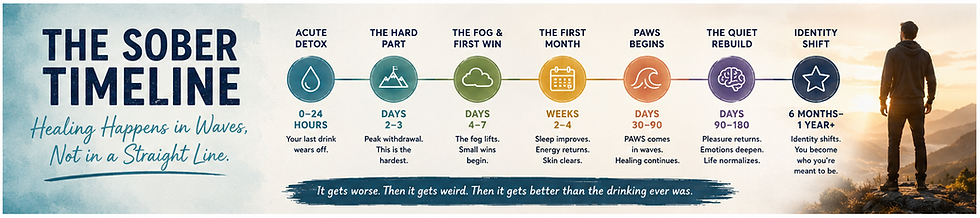
Days 4 to 7: The Fog and the First Win
Around day 4 or 5, something shifts. The shakes are gone. The sweating eases. You sleep one full night and wake up confused that you feel okay.
Then by day 6 or 7, the fog rolls in. Mental sluggishness, low mood, flat affect. Your brain is still rebalancing dopamine and GABA and your reward system is essentially offline. This is normal. It is also temporary.
What's improving by day 7: blood pressure starts dropping, liver inflammation begins to ease, blood sugar stabilizes, and acid reflux often clears.
What still feels bad: motivation, joy, sleep quality, sex drive. All of that comes back. Just not yet.
If you want to understand the cravings happening this week, we wrote a deeper post on how long alcohol cravings actually last and what to do when they hit.
Weeks 2 to 4: The First Month
By week 2, sleep starts deepening. You'll still have weird dreams (this can last months) but you'll get more REM and slow-wave sleep than you've gotten in years. Most people lose 2 to 5 pounds in the first month without trying, mostly water and inflammation.
By week 3 to 4, your skin starts looking different. Less puffy, less red, fewer broken capillaries. Hydration finally lands. People at work might say something.
Mentally, week 3 is where a lot of people hit the "is this it?" wall. The novelty of quitting wears off and you're left with regular life, sober, for the first time in a long time. This is where community matters more than information.
It's also where reading the right book at the right time can save you. If you haven't picked one up yet, here are the 10 best books for quitting drinking we recommend in the Sober Motivation community.
Days 30 to 90: Welcome to PAWS
Post-Acute Withdrawal Syndrome, or PAWS, is the part nobody warns you about. After acute detox ends, your brain keeps recalibrating for months. The symptoms come in waves: anxiety spikes, depression dips, brain fog, cravings out of nowhere, mood swings, sleep disruption.
PAWS isn't proof you're failing. It's proof your brain is healing. The symptoms come less often and with less force as you go.
What gets noticeably better between day 30 and day 90: liver enzymes (often back to normal range by day 60 to 90 in people without serious damage), resting heart rate, blood pressure, sleep architecture, and immune function. Many people stop getting sick as often.
What's still hard: random craving days, social events, evenings, vacations, fights with your partner. The body is fixing itself faster than the habits are.
If you can't sleep through this stretch, you're not broken. We wrote about why alcohol wrecks your sleep and exactly when it comes back so you know what's normal.
Days 90 to 180: The Quiet Rebuild
By day 90, you've passed the highest-relapse window. Your brain's dopamine receptors are returning to baseline. You start feeling pleasure from regular things again, food, music, walking, sex, conversation.
This is also when the emotional work tends to start, because you have the bandwidth for it. Stuff you drank to avoid will surface. Therapy hits different sober. So do friendships.
Physical changes by 6 months: liver fat can drop dramatically (research shows fatty liver often reverses within weeks to months in people who stop drinking entirely), blood pressure normalizes for most, weight stabilizes, hormones rebalance, and gut health improves.
This is also the stretch where people start getting real about what life looks like without drinking forever. Not as a punishment. As a relief.

6 Months to 1 Year: The Identity Shift
Somewhere between month 6 and month 12, you stop thinking of yourself as someone who quit drinking. You become someone who doesn't drink. Different sentence.
By the one-year mark, most people report:
Better sleep than they've had since their teens.
Stable mood with normal range emotions, not the chemical highs and lows.
Significantly lower risk of stroke, heart disease, and several cancers (alcohol is a confirmed Group 1 carcinogen, per the WHO).
Stronger relationships with people who matter.
Money in the bank that used to go to bars and Ubers.
The brain isn't fully rebalanced for some people until 18 to 24 months. PAWS can flare in year two. Cravings can come back during major stress. Sobriety stays a practice. It just stops being the hardest thing in your life.
What Most People Get Wrong About the Timeline
Most people expect a straight line. They count the days, then panic when day 47 feels worse than day 23.
Recovery is not linear. Your body and brain heal in waves, not stages. You'll have a great week 4 and a brutal week 7. You'll feel reborn at day 60 and like a stranger to yourself at day 88. That's the shape of healing. It doesn't mean you're doing it wrong.
The other thing people get wrong: they think the goal is to get back to who they were before drinking. The goal is to become who you were going to be without it. That person is different. Better, mostly.
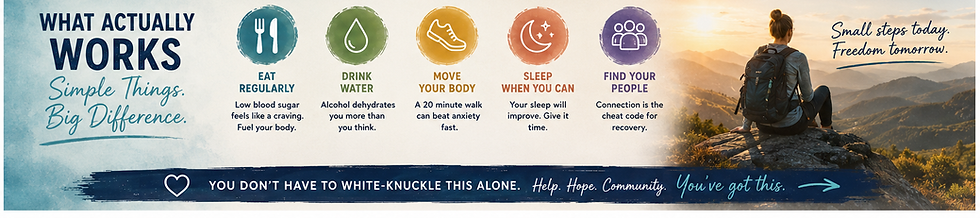
What Actually Works (To Get Through the Timeline)
A few things that help across every stage.
Eat regularly. Low blood sugar feels exactly like a craving, and your body is starved for nutrients alcohol stripped out.
Sleep when you can. Don't fight insomnia, just don't drink to fix it.
Move. A 20 minute walk does more for early-sobriety anxiety than most prescriptions.
Drink water. You're more dehydrated than you think.
Find people who are doing the same thing. This is the cheat code. Books and apps help. People help more.
You Don't Have to White-Knuckle This Alone
If you want to be around people who actually understand what week 3 feels like, come into the Sober Motivation community. It's free, there's no judgment, and it's full of people in every stage of this exact timeline. Plenty of them are happy to tell you what got them through the day you're on.
You can also listen to real stories from people who've walked the full timeline on the Sober Motivation Podcast. Hearing someone at year 5 talk about their day 7 changes something.
Want to Watch the Science?
If you'd rather watch than read, these are the videos that go deeper on what's actually happening in your body and brain at each stage of the timeline above.
Sober Motivation Podcast on YouTube. Long-form conversations with people who've walked this timeline already. Hearing someone at year 5 talk about their day 7 puts the hard early stages in perspective.
Andrew Huberman: "What Alcohol Does to Your Body, Brain and Health". The most-shared deep dive on alcohol's effects on the brain and body. Stanford neuroscientist Andrew Huberman walks through what alcohol does to your sleep, hormones, mood, and long-term health, and how those systems heal once you stop. Roughly 90 minutes. The single best companion to this timeline.
Dr. Anna Lembke: "Understanding and Treating Addiction". Stanford addiction psychiatrist Dr. Anna Lembke breaks down the dopamine cycle that drives drinking and explains why the early days feel so flat. If you've ever wondered why day 30 feels worse than day 3 in some ways, this video answers it. She wrote Dopamine Nation, and this Huberman Lab interview is the best free version of those ideas.
This Naked Mind YouTube Channel (Annie Grace). Annie Grace has a full library of free videos that walk through the cravings, the mental shifts, and the unconscious beliefs that make alcohol so hard to leave. Especially useful in your first 30 days when you can't read but can listen.
Dr. K (HealthyGamerGG): "Deep Dive into Addiction". A Harvard-trained psychiatrist explains addiction in plain language. Useful context for anyone trying to understand why their brain is doing what it's doing during the early timeline.
When to See a Doctor
Get medical care immediately if you experience:
Seizures or near-seizure shaking.
Hallucinations (visual or tactile).
Severe confusion or disorientation.
Resting heart rate over 120.
Repeated vomiting that won't stop.
Suicidal thoughts.
Heavy daily drinkers should consider medically supervised detox from the start. Outpatient programs exist. So do medications.
The Bottom Line
The first week is the worst week. The first month is the slow climb. The first 90 days is the rebuild. The first year is the rewrite.
Most people drink because they're afraid of how they'll feel without it. Then they quit and find out the feeling on the other side is better than anything alcohol ever gave them. That part doesn't show up in any timeline. It just shows up.
You're already further into this than you think. You searched. You're reading. That's the timeline starting.
Day 1 is the hardest day to start, and the easiest day you'll ever have to begin again.


Comments